
Ai in contract management: Accelerate Reviews and Mitigate Risk with AI
When you think about AI in contract management, don't picture a robot replacing lawyers. Instead, think of it as an expert co-pilot for your legal team. It’s designed to handle the repetitive, mind-numbing work so that lawyers can focus on high-value, strategic tasks.
This technology turns tedious manual reviews and data extraction into an intelligent, efficient workflow. It’s like having a skilled paralegal who never sleeps, ready to review, summarize, and flag critical clauses in a matter of seconds.
The New Reality of Legal Work with AI

Most legal teams know the feeling of being buried under a mountain of manual contract reviews. The traditional process is painfully slow, riddled with the potential for human error, and eats up resources that are desperately needed for actual legal counsel. That’s where AI in contract management comes in—not as some far-off concept, but as a practical solution you can use today.
This shift is part of a much larger AI digital transformation that's reshaping how entire industries operate. For legal professionals, it’s a chance to move from constantly putting out fires to proactively managing risk before it even starts.
Automating the Most Demanding Tasks
AI is at its best when it targets the most time-draining parts of the job. It's no surprise that enterprises are already using it for very specific contract functions to get a quick efficiency boost.
Recent numbers show that 44% of enterprises are using AI for metadata extraction—pulling key details like dates, names, and renewal terms from contracts instantly. Another 39% are focused on clause extraction to pinpoint critical terms, and 38% are using contract analytics to get a bird's-eye view of their entire portfolio.
By taking over this routine work, AI frees up legal teams to do what they do best: negotiate, strategize, and perform complex legal analysis. It shifts a lawyer's role from a document reviewer to a true strategic advisor.
Setting a New Standard for Efficiency
This technology gives legal teams, healthcare providers, and compliance officers a level of control over their contractual obligations that just wasn't possible before. It paves the way for a smarter, more responsive workflow that delivers some serious advantages.
- Enhanced Efficiency: AI cuts down the hours spent on manual reviews, which means teams can process agreements faster and keep business moving.
- Assured Consistency: It acts as a gatekeeper, enforcing standard language and company policies across all contracts to minimize rogue clauses and maintain a uniform approach to risk.
- Superior Risk Control: By automatically flagging non-standard terms or potential compliance gaps, AI adds a critical layer of oversight that a busy human reviewer might overlook.
Getting a handle on the intersection of law and AI is essential for any practice looking to stay competitive. The goal isn't to replace legal experts, but to arm them with tools that magnify their skills and judgment. Ultimately, that leads to better outcomes for both the firm and its clients.
How AI Actually Works in Contract Management
Let's cut through the buzzwords. When we talk about AI in contract management, we're not talking about a sci-fi robot lawyer. Think of it more like a team of incredibly fast, highly specialized paralegals who can read, understand, and organize legal language with superhuman speed and accuracy.
At its core, the technology works by learning from a massive library of existing legal documents—millions of them. By analyzing this data, the AI learns to recognize patterns, spot key information, and even grasp the context behind specific clauses. It’s not magic; it’s just incredibly powerful pattern recognition.
The engine driving all of this is Natural Language Processing (NLP), which is what gives software the ability to make sense of human language. If you want to dive deeper into the nuts and bolts, our guide on what is natural language processing is a great place to start. In simple terms, NLP is what allows the AI to move beyond a simple keyword search and actually interpret the meaning of a contract.
The Three Core Superpowers of Contract AI
Instead of one single "AI brain," you're really getting a set of three distinct capabilities that work together. Each one tackles a different part of the contracting process, turning a messy manual slog into a clean, data-driven operation.
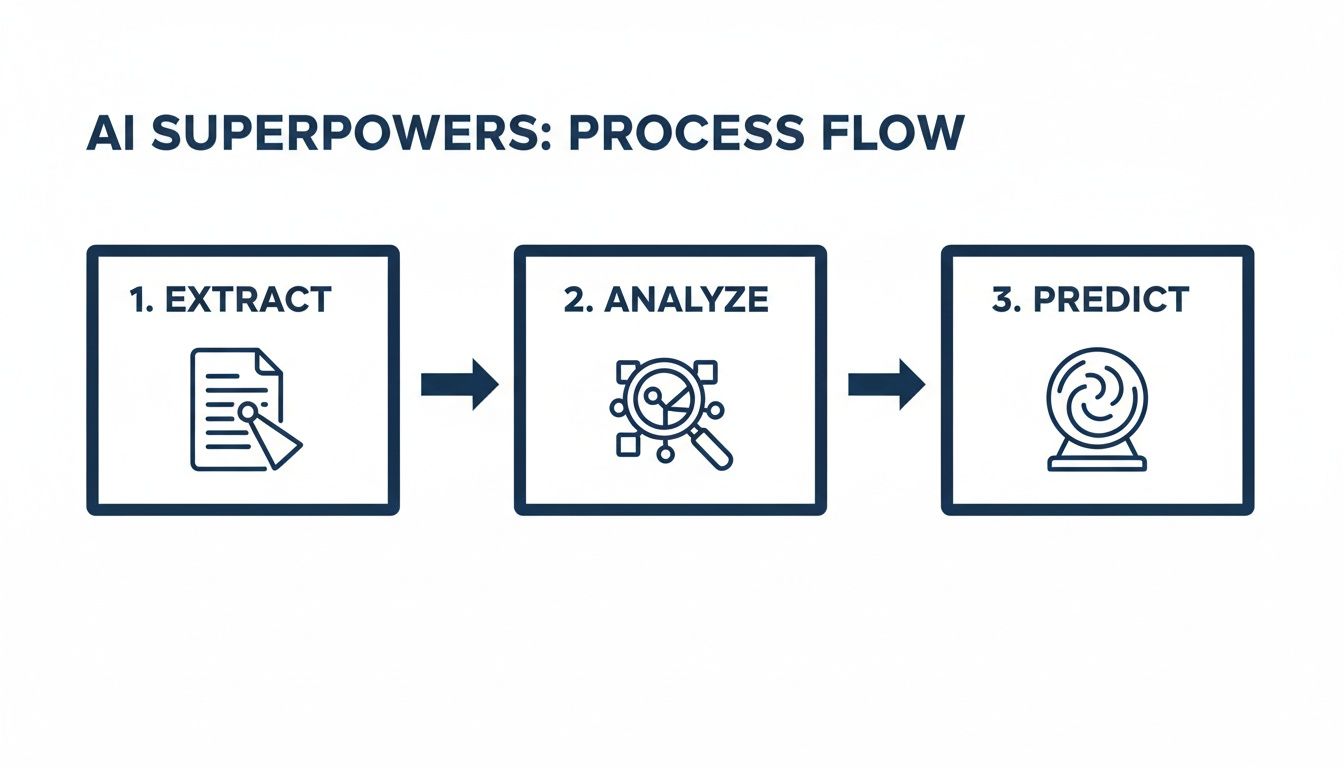
- Automated Data Extraction: This is the AI's ability to instantly read a contract and pull out all the critical information. It finds and neatly categorizes key details like party names, effective dates, renewal deadlines, and contract values. No more manual data entry.
- Intelligent Clause Analysis: The AI goes deeper than just finding data; it actually analyzes the substance of the contract. It can compare clauses against your company's standard templates or legal playbooks, automatically flagging any non-standard language, missing terms, or high-risk provisions that need a lawyer's eyes on them.
- Predictive Analytics: By looking across your entire contract portfolio, the AI starts to see the bigger picture. It can spot trends and forecast potential problems. For instance, it might highlight which clauses cause the most disputes down the road or which contract types are most likely to auto-renew without review, giving you a heads-up before issues arise.
AI transforms static, dense documents into dynamic, actionable intelligence. It’s the difference between having a library of books and having a librarian who has read every single one and can instantly find the exact sentence you need.
This system doesn't replace legal experts—it makes them more powerful. By handling the tedious first-pass review, the AI serves up a summarized, risk-assessed document. This frees up your legal team to focus their valuable time on high-level strategy, negotiation, and complex legal judgment.
A Side-by-Side Workflow Comparison
To see just how much of a difference this makes, let's look at how a typical workflow changes when you bring AI into the picture. The improvements in speed and strategic focus become crystal clear.
Traditional vs AI-Powered Contract Management Workflows
| Contract Task | Traditional Manual Method | AI-Powered Method | Key Benefit |
|---|---|---|---|
| Initial Review | A paralegal or junior lawyer manually reads the entire document, line by line, to find key terms and potential issues. This can take hours. | The AI scans the document in seconds, extracting all metadata and flagging any clauses that deviate from pre-approved standards. | Drastic time savings and immediate identification of primary risk areas. |
| Data Entry | Staff manually types key dates, obligations, and party details into a spreadsheet or CLM, creating a high risk of human error. | AI automatically extracts and populates all relevant data into a central repository, ensuring 100% accuracy and consistency. | Elimination of errors and the creation of a reliable, searchable contract database. |
| Risk Assessment | Relies entirely on the reviewer’s individual experience and memory to spot non-standard or risky language. Consistency can vary wildly. | The AI compares every clause against a "gold standard" playbook, assigning a risk score and highlighting critical areas for human review. | Superior risk control and enforcement of company-wide compliance standards. |
As you can see, the AI-powered approach offloads the repetitive, error-prone tasks. This doesn't just make the process faster; it elevates the role of the legal team from administrative gatekeepers to strategic business partners.
Transforming Your Entire Contract Workflow
When we talk about AI in contract management, we’re not just talking about speeding up a few isolated tasks. We're talking about a complete overhaul of the entire contract lifecycle. The old way—a choppy, manual sequence of steps—gets replaced by a single, intelligent workflow that flows smoothly from the initial request all the way through post-signature management.
Think of the traditional process like a messy assembly line with constant stops and starts, where information gets dropped at every handoff. AI connects everything, letting data move instantly and accurately from one stage to the next. Let's walk through what that actually looks like in practice.
From Intake to First Draft in Minutes
It all starts with the contract request, which for many teams is a chaotic mix of emails, Slack messages, and hallway conversations. AI brings some much-needed order to this first, crucial step by creating a smart, structured intake process.
For instance, you can streamline contract review requests with intelligent forms that capture all the necessary details right from the start. No more chasing down business teams for missing information. The system won't even let them submit the request until everything is there.
Once the request is logged, the AI gets to work on the draft. Instead of digging through folders for the right template, the system can:
- Automatically select the right template based on the contract type, region, or deal size.
- Populate key details like party names, effective dates, and payment terms pulled directly from the intake form.
- Insert pre-approved clauses from your central library, making sure every agreement starts on solid, compliant footing.
This step alone can shrink drafting time from hours down to just a few minutes. Your legal team is freed up to think strategically about the deal itself, not the administrative legwork.
Smarter Review and Negotiation
The back-and-forth of review and negotiation is where AI really proves its worth. It acts as an incredibly fast, detail-oriented paralegal for your team.
When a counterparty sends back a redlined draft, the AI scans it in seconds. It instantly compares their changes against your company's playbook and flags any deviations from standard terms. It can spot risky language, highlight unusual clauses, and even suggest pre-approved fallback positions from your clause library.
This means your lawyers can stop reading every single line and instead focus their expertise on the handful of critical issues the AI has surfaced. It’s a fundamental shift from tedious line-editing to high-level strategic oversight.
At its core, this part of the workflow runs on a simple but powerful loop: extract, analyze, and predict. The AI pulls the data from the document, analyzes it against your rules, and helps predict potential risks or opportunities.
This automated first pass ensures every document is thoroughly vetted before a human reviewer even opens the file, giving your team a huge advantage in any negotiation.
Proactive Post-Signature Management
A contract’s life doesn’t end when it’s signed—that’s really just the beginning. But managing obligations and renewals across hundreds or thousands of agreements is a nightmare. Too often, it falls to spreadsheets and calendar reminders, which is exactly how deadlines get missed and value gets lost.
AI flips post-signature management from a reactive headache into a proactive, strategic function. As soon as a contract is executed, the system automatically extracts and catalogs all key dates, obligations, and milestones.
AI acts as your digital watchdog, tirelessly monitoring your entire contract portfolio. It never misses a renewal date, forgets an obligation, or overlooks a compliance requirement.
The system builds a living dashboard that gives you a complete, real-time view of your entire contractual landscape. It pushes automated alerts to stakeholders for upcoming renewals, tracks performance against service-level agreements (SLAs), and flags compliance risks before they escalate.
This constant monitoring ensures the terms you fought for in negotiation are actually being met. By linking all these stages together, you can create a truly integrated system. To dig deeper, check out our guide to legal workflow automation software to see how all the pieces connect. This end-to-end approach ensures nothing falls through the cracks, from the very first request to the final obligation.
The Tangible Benefits of AI Adoption
While the tech behind AI in contract management is fascinating, let's be honest—what really matters are the results. It’s not about having fancy tools; it's about what those tools do for the business. Bringing AI into the mix isn't just a simple software upgrade. It’s a strategic decision that delivers real, measurable wins in efficiency, risk management, and your bottom line.
This is how the legal team shifts from being seen as a cost center to a genuine driver of business growth. By handing off the repetitive, foundational work to AI, legal pros can finally focus their brainpower where it counts: on tricky negotiations, strategic advice, and high-stakes planning. That pivot unlocks a whole new level of value for the entire company.
Gaining Radical Efficiency and Speed
The first thing you’ll notice when AI joins your contract workflow is the incredible speed. We’ve all been there—manual contract review is a notorious bottleneck, holding up deals and frustrating everyone involved. AI completely changes that dynamic by handling the time-sucking first-pass review.
AI tools can scan, analyze, and flag key issues in a document faster than you can grab a cup of coffee. This doesn't just speed things up; it makes the whole process smarter. For example, legal teams are already reclaiming huge chunks of their day by using AI to slash review times. One powerful case study showed a 95% reduction in executive review time. Instead of wading through 13 pages of dense legal text, leaders could just scan a 10-line AI summary to get the gist. Discover more insights on how AI is transforming contract management at aline.co.
That newfound speed means your legal department can handle more agreements without needing more people. The entire deal cycle moves faster, from the initial request all the way to the final signature. That means revenue gets recognized sooner and the business can operate with more agility.
Achieving Superior Risk Control
Let's face it, humans make mistakes. It’s an unavoidable part of any manual process. But in contract management, one missed clause can open the door to huge financial or legal problems. AI acts as a powerful safety net, bringing an unwavering consistency to every single review.
An AI doesn't get tired, distracted, or rushed. It applies the exact same rigorous analysis to the hundredth contract of the day as it did to the first.
Think of AI as your tireless compliance officer. It meticulously checks every agreement against your company's legal playbook, ensuring no risky clause or non-standard term slips through the cracks.
This automated oversight is a game-changer for staying on top of complex regulations and internal policies. You can train the AI on your specific risk appetite and approved language, empowering it to:
- Flag Deviations: Instantly spot any language that strays from your pre-approved templates.
- Enforce Standards: Make sure every contract lines up with company-wide governance and legal rules.
- Minimize Exposure: Catch high-risk terms around liability, indemnification, or data privacy before they become a fire drill.
By making risk detection a systematic, data-driven process, AI gives you a level of control over your contracts that was never possible before.
Unlocking a Clear Return on Investment
At the end of the day, the business case for AI in contract management hinges on a clear and compelling ROI. That return comes from both direct cost savings and the creation of new business value.
First, by getting contracts done faster, deals close sooner and revenue hits the books earlier. Second, by actively managing obligations and renewal dates, AI prevents money from leaking out through missed deadlines or unfavorable auto-renewals. And finally, it dramatically cuts the operational overhead tied to manual contract administration. Taking a look at the broader game-changing workflow automation benefits for business success helps put this in perspective.
This is about more than just saving time. It’s about transforming your contract portfolio from a dusty digital filing cabinet into a strategic asset that actively boosts your bottom line.
Choosing the Right AI Solution for Your Firm
Picking the right technology partner is easily one of the most critical decisions you'll make when bringing AI into your contract management workflow. This isn’t just another piece of software; it’s a platform that will become central to your operations, handling some of your most confidential client and firm data. The choice has to go far beyond a simple feature list—it's about finding a partner you can trust.
The market for this kind of tech is booming. The global contract management software market is expected to hit $12 billion by 2025, with some analysts predicting a growth rate of up to 27% for AI-specific tools well into the 2030s. As more firms jump in, it’s absolutely vital to partner with a vendor who takes security and responsible AI development as seriously as you do. You can find more stats on the growth of AI in contract management on juro.com.
This explosive growth means you have more options than ever, but it also means you have to be more discerning.
Core Evaluation Criteria for AI Vendors
When you start vetting potential vendors, your entire evaluation should hinge on three non-negotiable pillars: ironclad security, effortless integration, and a transparent, purpose-built AI model. Get one of these wrong, and the tool could create more problems than it solves.
A great place to start is by looking at a curated list of the top players. Our guide to the leading legal AI companies can help you build a shortlist of vendors who live and breathe the legal industry and its unique pressures.
The right AI partner doesn’t just sell you software; they provide a secure, integrated extension of your own high standards. Their commitment to data privacy and ethical AI should be as serious as your own.
Here are the key areas to dig into with any potential partner:
- Uncompromising Data Security: Your contracts are filled with incredibly sensitive information. Don't accept vague promises about security. Demand specifics on their protocols, like end-to-end encryption, regular third-party security audits, and secure data hosting in jurisdictions with strong privacy laws (like Switzerland or the EU for GDPR compliance).
- Seamless Integration Capabilities: An AI tool that operates in a silo is a workflow killer. You need to confirm that the platform can talk to the systems you already rely on. Ask about robust APIs and pre-built integrations for your document management system, email clients like Outlook, and other essential software.
- Transparent and Relevant AI Models: This is a big one. Ask vendors where their AI was trained. A generic, off-the-shelf model won’t cut it. You need an AI trained specifically on vast, high-quality legal and contractual datasets to ensure it understands legal nuance and delivers genuinely useful analysis.
Launching a Successful Pilot Program
Before you even think about a firm-wide rollout, a structured pilot program is the best way to prove the tool’s value. It’s your chance to test the technology in a real-world, controlled setting, gather honest feedback, and build a powerful business case backed by actual results.
Follow these steps to make sure your pilot delivers:
- Define Clear and Measurable Goals: Don't just "try out" the software. Set concrete targets. For instance, aim to reduce NDA review time by 50%, or slash the contract intake process from two days down to just four hours.
- Involve Key Stakeholders: Bring in a mix of people—the tech-forward lawyers who are excited about this and the seasoned veterans who are skeptical. Their combined feedback is gold for spotting both the platform's strengths and its potential friction points. Make sure paralegals, associates, and partners all have a voice.
- Start with a High-Impact Use Case: Pick a common, repetitive task that’s a known bottleneck. Think reviewing standard vendor agreements or generating routine client letters. A quick win in a painful area will build serious momentum and get people talking.
- Measure and Report on Success: Once the pilot period is over (usually 60-90 days), gather your data. Look at the hard numbers (time saved, errors caught) and the qualitative feedback from your users. Package these findings and present them to leadership to show a clear return on investment and justify the next step.
Answering Your Questions About AI in Contract Management
Whenever a new technology shows up with this much promise, a healthy dose of skepticism is a good thing. It’s only natural. When legal pros start digging into AI for contract management, they tend to ask the same smart questions about security, real-world value, and how it will affect their day-to-day work. Let's tackle those head-on.
Will AI Replace Lawyers or Paralegals?
Plain and simple: no. This isn't about replacing legal professionals; it's about making them more effective.
Think of an AI tool as the world's most diligent junior associate. It can take on the tedious, mind-numbing tasks—like sifting through a 50-page agreement to find the liability clause or pulling key dates from a stack of leases. This frees you up for the work that actually requires a human brain: negotiating a tricky indemnity clause, advising a client on strategic risk, or crafting a novel legal argument.
AI delivers the data, but the judgment, the ethical considerations, and the client relationships? That’s all you.
How Secure Is Our Sensitive Contract Data?
In the legal world, data security is everything. It's a deal-breaker, and vendors in this space know it. The most reputable AI platforms are built on a foundation of enterprise-grade security designed to protect your firm's and your clients' most confidential information.
When you're vetting a potential tool, you need to get specific. Don't just take their word for it; ask about their security protocols.
- End-to-end encryption: Is your data protected while it's moving and while it's stored?
- Secure hosting: Where does the data physically live? For GDPR compliance, you might need servers in the EU or a country with equivalent privacy laws, like Switzerland.
- Granular access controls: Can you ensure that only the right people on your team can see specific documents or folders?
Ask to see their security certifications and data handling policies. A vendor who takes security seriously will be transparent and ready to answer these questions.
How Long Does It Take to Implement and See Value?
This isn't one of those massive, year-long IT overhauls from a decade ago. Modern, cloud-based AI tools are built for speed. Many firms can get a pilot up and running and start seeing a real return on their investment within 60 to 90 days.
The trick is to start small and smart. Don't try to boil the ocean. Pick one high-pain, high-volume task to start with. A classic example is automating the first-pass review of Non-Disclosure Agreements (NDAs). It's a perfect way to prove the concept, get a quick win, and build buy-in for rolling it out more widely.
A good vendor won’t just sell you software and disappear. They’ll be a partner, helping you with onboarding, identifying that perfect first use case, and making sure you can measure the impact right from the start.
Can AI Understand Our Firm's Unique Contracts?
Yes, and this is absolutely critical. A generic, off-the-shelf AI isn't going to cut it. The best systems come pre-trained on millions of legal documents, but their real power lies in their ability to adapt to your way of doing things.
You can—and should—train the AI on your firm's own templates, your preferred clause language, and your specific risk tolerance. It learns what you consider a high-risk liability cap or which non-compete language is acceptable. Over time, the AI becomes an extension of your firm's institutional knowledge, ensuring every contract it touches is aligned with your standards.
Ready to see how a voice-first AI workspace can transform your legal workflow? Whisperit unifies dictation, drafting, and collaboration to help your team move from intake to export in fewer steps. Learn more about Whisperit and book a demo today.