
Contract "contract management ai": Streamline Your Contracts with AI
Picture this: you're trying to find one specific clause buried in a mountain of paper contracts. Now, imagine using a smart search that actually understands legal language to find it in seconds. That's the jump we're making with contract management AI. It takes slow, risky manual work and turns it into a fast, intelligent workflow, transforming static documents into活 assets that unlock real business insights.
How AI Is Transforming Contract Management
Traditional contract management feels a lot like navigating a cross-country road trip with a faded paper map. Sure, you might eventually get where you’re going, but the process is agonizingly slow, full of wrong turns, and demands your full attention. It's easy to miss a critical detour sign—or in this case, a risky clause or an looming renewal date—and end up with serious delays and unexpected costs. This old-school approach isn't just inefficient; it's a huge source of business risk.
Contract management AI is your real-time GPS for that same trip. It doesn’t just show you the map; it analyzes the traffic, points out faster routes, and alerts you to hazards before you run into them. By taking over the tedious, repetitive tasks, it frees up your legal and business teams to focus on high-level strategy instead of getting bogged down in administrative muck. To really appreciate this change, it helps to first understand what a contract management system is at its core.
The Shift from Static Documents to Dynamic Assets
The fundamental problem with old-school contract management has always been that agreements are treated like static files, locked away in a filing cabinet or a forgotten digital folder. All the valuable information inside is trapped, making it nearly impossible to access or analyze. AI completely flips this script, making contracts "live" and interactive.
Here’s a look at how that transformation happens:
- Automated Insights: AI reads and truly understands the language in your contracts. It can automatically pull out key data points like important dates, party obligations, and any unusual clauses.
- Proactive Risk Mitigation: Forget manual line-by-line reviews. AI instantly flags potential risks, compliance gaps, or any language that deviates from your company’s standard playbook.
- Enhanced Searchability: Finding what you need becomes incredibly simple. You can search for abstract concepts—not just specific keywords—across your entire contract portfolio.
This isn't just a niche tool anymore; it's becoming central to business operations. The market data tells the story: in 2023, the AI in contract management market was valued at USD 359.6 million. It's projected to explode to USD 3,987.4 million by 2033.
This is a fundamental change in how businesses manage their most critical documents. To see how this technology impacts the bigger picture, our complete legal AI software guide explores how these tools are changing the entire legal field. By turning passive documents into active, intelligent assets, AI is clearing the path for smarter, more strategic contract workflows.
Understanding the Core Capabilities of AI
To really get what AI-powered contract management can do, we need to look under the hood. It’s not some kind of magic wand; it's a set of smart, practical tools that automate the grunt work and pull out the insights that actually matter. These features work together to turn a static PDF into a dynamic asset that actively protects and grows your business.
At the heart of it all is a technology that reads and understands legal text, much like a lawyer would, but at a speed and scale that’s simply not humanly possible. This comes from a field called Natural Language Processing (NLP), which gives the software the ability to grasp context, spot patterns, and pull specific information out of dense paragraphs. You can get a more detailed look at what Natural Language Processing is and how it all works.
AI-Powered Analysis And Review
Ever been handed a 100-page Master Service Agreement on a Friday afternoon with a deadline of Monday morning? That used to mean a weekend of painstaking, line-by-line reading, where one moment of fatigue could mean missing a high-risk clause.
AI-powered analysis flips that whole process on its head.
The system scans the entire document in seconds. It compares every single clause against your company's own legal playbook or established best practices. It instantly flags things like:
- Deviations from Standard Terms: Any language that doesn’t match your pre-approved wording gets highlighted immediately.
- Missing Clauses: It can tell if a critical section—like limitation of liability or data privacy—is completely missing.
- High-Risk Language: The AI is trained to recognize ambiguous or risky phrasing that could cause major headaches down the road.
Think of it as a super-powered first-pass review. It frees up your legal team to focus on strategic advice instead of just hunting for mistakes.
Automated Data Extraction And Tagging
Contracts are goldmines of crucial data: renewal dates, payment terms, key obligations, termination windows, and so on. For years, the only way to get this information was to have someone manually read the document and type everything into a spreadsheet. It’s slow, tedious, and a breeding ground for human error. One mistyped date could mean an unwanted auto-renewal costing you thousands.
Automated data extraction completely gets rid of this manual drudgery. The AI reads the contract and intelligently pulls out these key pieces of information—the metadata—all on its own.
It then populates a central dashboard, creating a structured, searchable record for every single agreement. For example, it can instantly grab the "Effective Date," "Termination Notice Period," and "Auto-renewal Date," and then set up automated reminders so your team never misses a critical deadline again. This turns a dense legal document into a neat set of actionable data points.
The infographic below shows just how big of a leap this is from disorganized, manual methods to a smart, AI-driven approach.
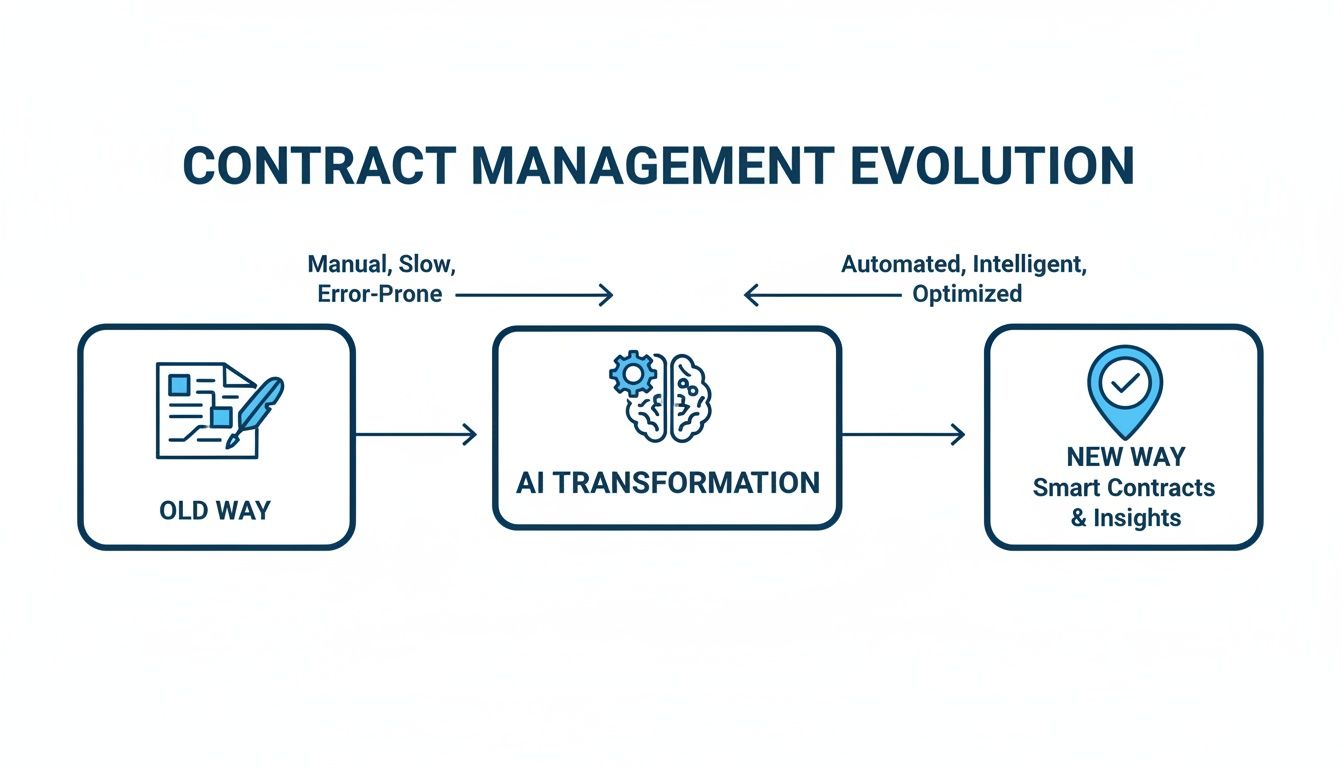
This visual really captures how AI acts as the bridge, taking us from the old, paper-based way of working to a modern, precise system for managing contracts.
AI-Assisted Drafting And Negotiation
The final piece of the puzzle is how contract management AI helps create and finalize deals faster. Instead of starting from a blank page or a dusty old template, teams can use AI to build new contracts from a library of pre-approved clauses. When drafting a new agreement, a user just selects the contract type, and the AI assembles a solid first draft using the correct, compliant language every time.
Then, during negotiations, the AI can step in to help. When the other side redlines a section, the system can suggest alternative wording from your approved clause library, making sure any changes stay within your company's risk tolerance. It also keeps a clean, easy-to-follow version history, so you can see exactly who changed what and when. This doesn't just speed up deal cycles; it maintains a high standard of quality across all company agreements, which is essential for scaling a business without scaling the risk.
What This All Means for Legal and Business Teams
It’s one thing to talk about the tech behind AI contract management, but the real magic happens when you see how it changes the daily grind for legal, sales, and procurement teams. Let's get past the features and look at the real-world impact. This isn't about abstract gains; it's about giving your teams measurable boosts in speed, accuracy, and security.
You can really boil down the benefits into three main buckets: getting more done faster, keeping everything consistent, and—most importantly—slashing your risk. For anyone who's ever spent a morning digging through folders for one specific clause, the change is night and day.

Boosting Team Efficiency
The first and most obvious win is how much time you get back. Right now, your legal experts are probably spending way too much of their day on administrative grunt work instead of the high-value strategic thinking you hired them for. AI takes the tedious stuff off their plate.
Think about it: AI can cut the time spent on contract review by as much as 70%. A lawyer who would have spent half a day poring over a dense vendor agreement can now let the AI do the first pass in minutes. The system flags risky language and non-standard terms, so the human expert can jump straight to the parts that actually need their brainpower. We get into the specifics of this process in our guide to AI contract review software.
And it's not just for lawyers. A procurement team juggling hundreds of supplier agreements can use AI to pull key dates automatically. This simple step can eliminate 90% of missed renewal deadlines, saving the company from getting stuck in costly auto-renewals for services it no longer needs.
Ensuring Ironclad Consistency
Inconsistency is the silent killer in a contract portfolio. When different people are using different templates and negotiating their own terms, you end up with a chaotic mess of obligations. AI acts as a central guardrail, making sure everyone sticks to the same standards.
Here’s how it pulls that off:
- Standardizing Clause Usage: AI drafting tools pull from a library of pre-approved clauses. No more rogue language finding its way into a signed agreement.
- Enforcing Playbooks: As negotiations happen, the AI constantly checks redlines against your company’s playbook, immediately flagging any proposed changes that go beyond your accepted level of risk.
- Creating a Single Source of Truth: With every contract and its data in one place, everyone from sales to legal is working with the same information. Finally.
For a business, this means that the terms negotiated by the sales team in New York are just as compliant and protective as those drafted by the legal team in London. This level of consistency is nearly impossible to achieve manually at scale.
Reducing Business Risk
At the end of the day, a good contract management process is all about minimizing risk. AI helps you get ahead of problems instead of just reacting to them. Rather than finding a problematic clause after something has gone wrong, the AI flags it before anyone signs.
This is a game-changer for regulated industries. A healthcare organization can use AI to scan clinical trial agreements and confirm they meet strict compliance standards, protecting patient data from the get-go. For a security team, it means automatically checking that every new vendor contract contains your mandatory data protection addendum.
This proactive approach to risk is probably the most powerful advantage AI brings to the table. It lets you plug security and compliance holes before they ever become a real threat.
Navigating the Challenges of AI Adoption
Bringing any new technology into an established workflow is always a bit of a dance. AI-powered contract management is no different. The promise of saving time and cutting down on risk is powerful, but getting there smoothly means being realistic about the hurdles. It's not just about buying software; it's about smart planning around data, integration, and, most importantly, the people who will use it every day.
A successful rollout is more of a marathon than a sprint. It means listening to your team's real concerns and mapping out a practical path forward. By thinking ahead about potential bumps in the road, like user resistance or tricky data migration, you can build a strategy that ensures the technology doesn't just work—it gets used. The whole point is to move forward confidently, ready to manage the entire process.
Securing Your Most Sensitive Data
The second you think about moving contracts to a new platform, security has to be front and center. These documents are packed with a company's most sensitive information, from financial details to strategic plans. Trusting an AI system with that data means demanding ironclad security from your technology partner.
To keep your data safe, there are a few non-negotiables:
- Encryption at Rest and in Transit: This is the absolute baseline. Your contract data must be encrypted when it's just sitting on a server and when it's moving across the network.
- Strict Access Controls: Not everyone in the company should be able to see every contract. Role-based access controls are essential to make sure people can only view or edit the documents they actually need for their job.
- Data Residency and Compliance: Where is your data physically stored? For many businesses, especially those in Europe dealing with GDPR, the answer to this question is critical for staying compliant.
As organizations implement AI, understanding and adhering to evolving AI governance laws becomes a critical aspect of responsible adoption. This isn't just a technical issue; it's a fundamental part of maintaining legal and regulatory compliance.
Managing Change and Encouraging Adoption
Let's be honest: even the most amazing tool is useless if nobody uses it. Hesitation from the team is one of the biggest reasons new software projects fall flat. People get comfortable with their routines, and any change can feel like a disruption. The only way to get past this is with a thoughtful, human-centered change management plan.
Instead of a top-down mandate that lands with a thud, try a more gradual and inclusive approach. A phased rollout lets you build momentum, prove the value in a controlled way, and make the whole process feel less like a directive and more like a collective upgrade. For a closer look at this, check out our guide on AI governance best practices.
Here are a few proven strategies to get your team on board:
- Launch a Pilot Program: Start small. Pick a receptive team—maybe sales ops or procurement—and let them test the tool on a real project. Their feedback will be invaluable, and their success will become your best internal case study.
- Identify Internal Champions: Find those few people who are genuinely excited about the new tool and empower them. These "champions" are fantastic for peer-to-peer training and for sharing positive stories that make the software feel less intimidating.
- Provide Hands-On Training: Forget generic demos. Run practical, role-specific training that shows each person exactly how the AI will make their job easier. When people see the direct benefit, skepticism quickly turns into genuine interest.
How to Measure Your Return on Investment

Bringing in any new technology demands a solid business case. For contract management AI, showing its value is surprisingly straightforward once you know what to look for. Measuring the return on investment (ROI) isn't just about justifying the initial cost; it's about seeing the profound effect AI has on your daily operations, risk exposure, and ultimately, your bottom line.
To see the full picture, you need to track both the hard numbers (your quantitative metrics) and the less tangible—but equally critical—strategic wins (your qualitative metrics). This blended approach proves how AI pays for itself not just by cutting costs, but by making your whole organization smarter and more resilient.
Calculating Your Quantitative Gains
Quantitative ROI is all about the concrete, measurable data that speaks in dollars and cents. These are the numbers your finance team will appreciate because they draw a straight line from the investment to real savings or increased revenue.
You can start by tracking a few key performance indicators (KPIs):
- Faster Deal Cycles: Clock the average time it takes to get from a draft to a final signature, both before and after AI. Shaving even a few days off this cycle can mean getting revenue in the door much faster.
- Reduced Legal Spend: Tally up the hours your team sinks into routine contract reviews or the fees you pay external counsel for the same work. AI can slash review time by up to 70%, freeing up that budget and your best people for more strategic work.
- Eliminated Missed Renewals: Keep a running total of the money lost to contracts that auto-renewed when they shouldn't have, or the opportunities missed because you forgot to renew a valuable one. AI alerts can make these expensive slip-ups a thing of the past.
These metrics build a clear financial story. For example, if your legal team gets back 20 hours a week on reviews, and their time is valued at $150 an hour, that’s $3,000 per week in direct savings. This kind of data-driven insight is fundamental to smart resource allocation optimization, ensuring your people are focused where they can make the biggest impact.
Assessing Your Qualitative Wins
Qualitative benefits are just as powerful, even if you can't always slap a price tag on them. These gains are about reducing risk, staying compliant, and building better internal workflows—all of which have a huge long-term financial upside.
While you can't always put a price tag on dodging a lawsuit, the value is undeniable. Qualitative ROI is about measuring the problems you didn't have thanks to a smarter system.
Here are the key qualitative improvements to watch for:
- Improved Compliance and Risk Mitigation: By using standard clauses and automatically flagging risky language, AI dramatically lowers the chance of ending up in a costly legal battle or facing regulatory penalties.
- Enhanced Cross-Departmental Collaboration: When contracts live in one intelligent, central hub, the walls between legal, sales, and procurement come down. Workflows become smoother and everyone is on the same page.
- Greater Contract Visibility: Imagine being able to instantly pull insights from thousands of agreements. That’s the kind of visibility that gives leadership the confidence to make better, more informed strategic decisions.
Got Questions About AI in Contract Management?
It's only natural to have questions when you're looking at a tool that changes how you work. Once you get past the slick feature lists and benefit claims, the real questions pop up—the ones about your people, your data, and what this actually looks like day-to-day. Getting straight answers is the only way to feel confident enough to take the next step.
Here, we'll tackle the most common questions we hear from legal, healthcare, and security teams, cutting through the noise to give you the clear explanations you need.
Is AI Going to Replace Lawyers or Paralegals?
Let's get this one out of the way first. The answer is a hard no. Contract AI isn't here to replace legal professionals; it’s here to make them better, faster, and more focused. Think of it less as a replacement and more as the world's most efficient legal associate, one that never gets tired of the grunt work.
AI is fantastic at the tedious, time-sucking tasks—like sifting through hundreds of contracts to find a specific indemnification clause or automatically flagging non-standard terms. This frees up human experts to concentrate on the work that actually requires a human brain:
- Strategic Negotiation: Building a compelling case during a critical deal.
- Complex Legal Analysis: Untangling tricky legal gray areas where context and judgment are everything.
- Client Relationships: Providing the nuanced advice and counsel that builds lasting trust.
By offloading the administrative heavy lifting, AI lets your legal team operate at a much higher level, where their expertise truly makes a difference.
How Secure Is Our Sensitive Contract Data?
This is a big one. We're talking about handing over documents filled with everything from trade secrets to financial data. Security isn't just a feature; it's the foundation of trust. Any worthwhile contract AI platform is built from the ground up with security as the top priority, layering protections to keep your data locked down.
The philosophy is simple: your data must be protected at all times, whether it's sitting on a server or being sent over the internet. This is non-negotiable and requires enterprise-grade security.
Look for these essential security measures:
- End-to-End Encryption: Your data is essentially scrambled into an unreadable code during transit and while it's stored. To an outsider, it’s just noise.
- Strict Access Controls: You decide who sees what. Role-based permissions mean people only have access to the specific contracts and information they absolutely need for their job.
- Compliance Certifications: The platform must meet rigorous international standards like GDPR. This isn't just a promise; it's verifiable proof that they take data privacy and security seriously.
What Kind of Training Will My Team Need?
Gone are the days of spending weeks in training seminars just to learn a new piece of software. Modern AI tools are designed to be intuitive. The goal is for the technology to feel like a natural part of your team's workflow, not another complicated system they have to fight with.
Onboarding should be quick and focused on real-world use. A good training program shows your team how the tool solves their problems. A paralegal can learn to pull key dates and party names in minutes. A senior counsel can run a risk analysis across a dozen agreements with a few clicks. The right platform means your team starts seeing the benefits almost immediately, not months down the road.
Ready to see how a voice-first, case-centric workspace can reshape your contract workflows? Whisperit brings together dictation, drafting, and teamwork with a contextual AI Navigator that actually understands what you need. Explore Whisperit and see how it works.