
A Guide to Diligence Security Solutions for Legal and Healthcare
When you're handling incredibly sensitive information during high-stakes business deals, you need more than just standard cybersecurity. That's where diligence security solutions come in. Think of them less as a simple lock on a door and more like a purpose-built, climate-controlled vault with around-the-clock surveillance, designed specifically for things like mergers, litigation, or exchanging patient records.
Defining Your Digital Vault
Picture your most critical client data—be it merger agreements, protected health information, or priceless intellectual property. You wouldn't just leave those files sitting on a shared drive protected by a single password. You'd want them in a dedicated, high-assurance environment built to keep them safe. That’s the entire idea behind a diligence security solution.
These systems are a world away from general IT security. A standard firewall is great for protecting the network perimeter, but a diligence security solution carves out a fortified digital space for a specific, high-risk job. It’s an active strategy built on verifiable protection, not just a passive defense waiting for something to go wrong.
The Pillars of a Secure Diligence Environment
A truly secure diligence environment isn't built on a single piece of technology. Instead, it rests on several core pillars that work in concert to create a nearly impenetrable shield around your data. Getting a handle on these components is the first step toward building a workflow you can actually trust.
To make this clearer, let's break down the essential pieces of a strong diligence security framework.
Core Components of a Diligence Security Framework
| Security Component | Primary Function | Why It's Critical for Due Diligence |
|---|---|---|
| Advanced Encryption | Scrambles data so it's unreadable to anyone without the key, both when stored (at rest) and while being sent (in transit). | Acts as the vault's reinforced steel door. Even if data is intercepted, it remains completely useless to unauthorized parties. |
| Granular Access Controls | Defines exactly who can access, view, or edit specific files and folders, and what actions they can perform. | This is your sophisticated keycard system. It ensures that stakeholders see only the information they absolutely need, preventing accidental exposure. |
| Immutable Audit Trails | Creates a detailed, unchangeable log of every action: who accessed what, when they did it, and what they did with it. | This is the 24/7 surveillance footage inside the vault, providing a crucial, tamper-proof record for compliance and forensic analysis. |
These components are the bedrock of any serious security solution, providing multiple layers of defense and accountability.
A great way to understand the thinking behind these solutions is to look at established compliance frameworks. For example, learning the basics from a plain-English guide to SOC 2 compliance shows you the kind of verifiable, trustworthy security posture you should be aiming for. It's all about building a system that doesn't just claim to be secure but can prove it. The principles of a zero-trust security model, which you can learn more about here https://www.whisperit.ai/blog/what-is-zero-trust-security, are also fundamental, operating on the mantra "never trust, always verify."
This isn't just a niche concern, either. The growing demand for these robust systems is easy to see in the market numbers. The global security solutions market, valued at about USD 443.12 billion in 2025, is on track to hit over USD 692 billion by 2029. That kind of growth signals a major shift in how organizations are prioritizing and investing in high-assurance security.
Why Compliance Demands Ironclad Security
In sensitive fields like law and healthcare, data security isn't just good practice—it's a legal and ethical cornerstone. When regulations have the force of law, simply hoping for the best with sensitive data is not an option. This is why organizations are compelled to adopt robust diligence security solutions that can stand up to intense scrutiny.
Take the Health Insurance Portability and Accountability Act (HIPAA) in the United States. It lays out strict, non-negotiable standards for protecting patient health information. One misstep can trigger massive fines, government-mandated corrective actions, and a catastrophic loss of public trust. The same goes for Europe's General Data Protection Regulation (GDPR), which holds any organization handling EU citizen data to an incredibly high standard, no matter where it’s based.
Failing to comply isn't just a business risk; it's a direct threat to your organization's survival. The combination of financial penalties and shattered client trust can easily cripple a law firm or healthcare provider, making proactive security a non-negotiable cost of doing business.
Turning Rules into Real-World Protections
These regulations are what turn the fuzzy idea of "security" into a concrete checklist of actions. It's no longer enough to claim your data is safe. You have to be able to prove it with detailed audit trails, access logs, and documented controls. This critical shift from promise to proof is where compliance truly drives security strategy.
Attorneys, for instance, have an ethical duty to be technologically competent. The American Bar Association's rules explicitly require lawyers to take "reasonable steps" to prevent unauthorized access to or disclosure of client information. A generic, off-the-shelf cloud drive just doesn't cut it when you're dealing with confidential M&A documents or sensitive case files.
To satisfy these strict demands, organizations need to implement specific, demonstrable measures:
- Verifiable Data Handling: You must have a clear, unalterable record of who touched what data and when. This isn't optional—it's essential for passing audits and handling legal discovery requests.
- Secure Data Disposal: Regulations often specify that data must be securely destroyed when no longer needed. A hard drive certificate of destruction is a perfect example of the kind of proof required to show you're following the rules.
- Incident Response Planning: You need a tested, documented plan for what to do when—not if—a breach happens. This is a fundamental requirement in most compliance frameworks. For a closer look at the specifics, you can explore a comprehensive HIPAA compliance requirements checklist.
The Market Response to Mandated Security
This intense regulatory pressure is the engine behind a rapidly growing security market. The U.S. security market alone was valued at USD 42.25 billion in 2025 and is on track to nearly double, hitting USD 85.31 billion by 2034.
What's driving this? It's the combination of strict regulations mandating security installations and a heightened awareness of cyber threats. This creates a powerful, sustained demand for solutions that don't just work but also satisfy auditors and regulators. The numbers make it clear: investing in compliance-driven security isn't a passing trend, it's a core business imperative.
What to Look For in a Secure Platform

When you're trying to pick a platform, it’s easy to get lost in a sea of technical jargon. Vendors often throw around buzzwords, but what really matters? A genuine diligence security solution isn't about flashy marketing—it's about concrete, verifiable features that protect your most critical work.
These aren't just bells and whistles. They're the core components that distinguish a basic tool from a platform truly built for high-stakes legal and healthcare environments. Let's get practical and look at the non-negotiables that create a secure space you can actually depend on.
Essential Data Protection Mechanisms
The first line of defense is simple: make your data useless to anyone who isn't supposed to see it. This all comes down to strong encryption that shields information no matter where it is.
- End-to-End Encryption: Think of this as sealing a letter in a tamper-proof envelope before it ever leaves your hands. Data is scrambled the instant it leaves your device and only becomes readable when it reaches the right person. This keeps it safe both in transit (as it travels over the internet) and at rest (when it's sitting on a server).
- Secure Data Residency: You need to know exactly where your data lives. For compliance, this is non-negotiable. Look for platforms that guarantee hosting in specific regions, like Switzerland or the EU, which is essential for meeting strict regulations like GDPR.
These features lock your information in a digital vault. But you also need to control who has the keys.
Controlling and Proving Access
Real security is about precision—giving the right people access to the right information, at the right time. This is where detailed access controls and immutable logs come into play.
The single most important thing to ask a vendor is for proof. Can they show you, without a doubt, that you are meeting your security and compliance duties? A tamper-proof audit trail is what turns a security promise into a legal fact.
Imagine you're in the middle of a complex merger negotiation. A junior associate needs to see some documents, but they absolutely cannot have access to the sensitive partner-level financials in the same project folder. This is precisely what role-based access controls (RBAC) are for. They let you assign permissions with surgical accuracy, dictating who can view, edit, or download what. If you're curious about the mechanics, you can dive deeper into a practical guide on role-based access control implementation.
Finally, think of an immutable audit trail as the platform's security camera. It records every single action—who opened a file, when they did it, and what they did with it—in a log that cannot be altered. If a regulator ever comes knocking or a client questions your process, this verifiable record is your best defense, proving you took every necessary step to safeguard their information.
How Whisperit Builds Diligence-Ready Security
It’s one thing to talk about the features of a secure platform, but it’s another to see them all work together in a single, cohesive system. Whisperit closes that gap by building the principles of diligence security solutions right into its DNA. This isn’t just another productivity tool with security bolted on; it’s a fortified environment, designed from day one to protect the high-stakes work of legal and healthcare professionals.
This commitment begins with where your data physically resides. For any firm grappling with the complexities of GDPR, Whisperit provides Swiss and EU hosting options. This is far more than a minor detail—it's a direct solution for strict data residency rules, guaranteeing your most sensitive information stays within jurisdictions celebrated for their strong privacy laws.
Encryption as the Default Standard
At Whisperit, we operate on a simple yet powerful premise: every single piece of information deserves the highest level of protection. That's why the platform uses end-to-end encryption for absolutely all communications and documents. In plain terms, your data is scrambled the moment it leaves your device and only becomes readable again when it reaches its intended recipient. No one in between can decipher it.
This protection is woven into every part of your workflow.
- Secure Client Intake: Right from that first conversation, every piece of client information is captured and stored in an encrypted space.
- AI-Powered Collaboration: When you use AI to draft a contract or summarize case files, all that processing happens inside Whisperit's secure bubble. Your confidential data is never, ever used to train outside models.
- Final Document Export: The security follows your work through its entire lifecycle, making sure that even the finished product is handled with the utmost care.
This creates a continuous shield of encryption, leaving no weak spots in your data handling process.
Verifiable Control and Transparency
A true diligence security solution has to offer more than just a promise of protection—it has to provide proof. Whisperit delivers on this with transparent controls and comprehensive logging, giving you all the tools you need to manage and verify access with total confidence.
Whisperit is built to earn the trust of professionals handling the world's most sensitive information. This is achieved by making security an intuitive, transparent, and non-negotiable part of the user experience, transforming a complex requirement into a simple reality.
The platform's security settings are refreshingly clear and easy to use. You can set up granular permissions without needing a dedicated IT team, easily defining who can see certain cases, files, or features. This ensures team members and clients only ever have access to the information they’re authorized to view.
Plus, every action taken is recorded in a detailed audit log. This provides the verifiable proof you need to sail through compliance audits and satisfy even the most demanding client security reviews. It turns security from an abstract feature into a tangible asset. To see the full picture, you can learn more about Whisperit’s comprehensive security framework and our commitment to transparency.
Ultimately, Whisperit offers a dedicated, fortified workspace where security isn’t an afterthought—it’s the bedrock. This integrated approach lets legal and healthcare teams concentrate on their critical work, knowing their data is safe within a system built for the unique challenges they face every day. It's more than a tool; it's a trusted environment for diligence.
Your Roadmap to Implementing Secure Solutions
Bringing a new security platform into the fold can feel like a massive undertaking, but with a clear plan, it becomes a straightforward and successful project. Think of it like building a custom home: you wouldn't start pouring concrete without a detailed blueprint. This roadmap is that blueprint for putting effective diligence security solutions in place.
The journey always starts with a serious risk assessment. This isn't just about making educated guesses; it's a methodical hunt for your organization's unique weak spots. Where does your most critical data live? Who can get to it? What would be the real-world financial and reputational fallout from a breach? Getting honest answers to these questions is how you figure out what you really need to protect.
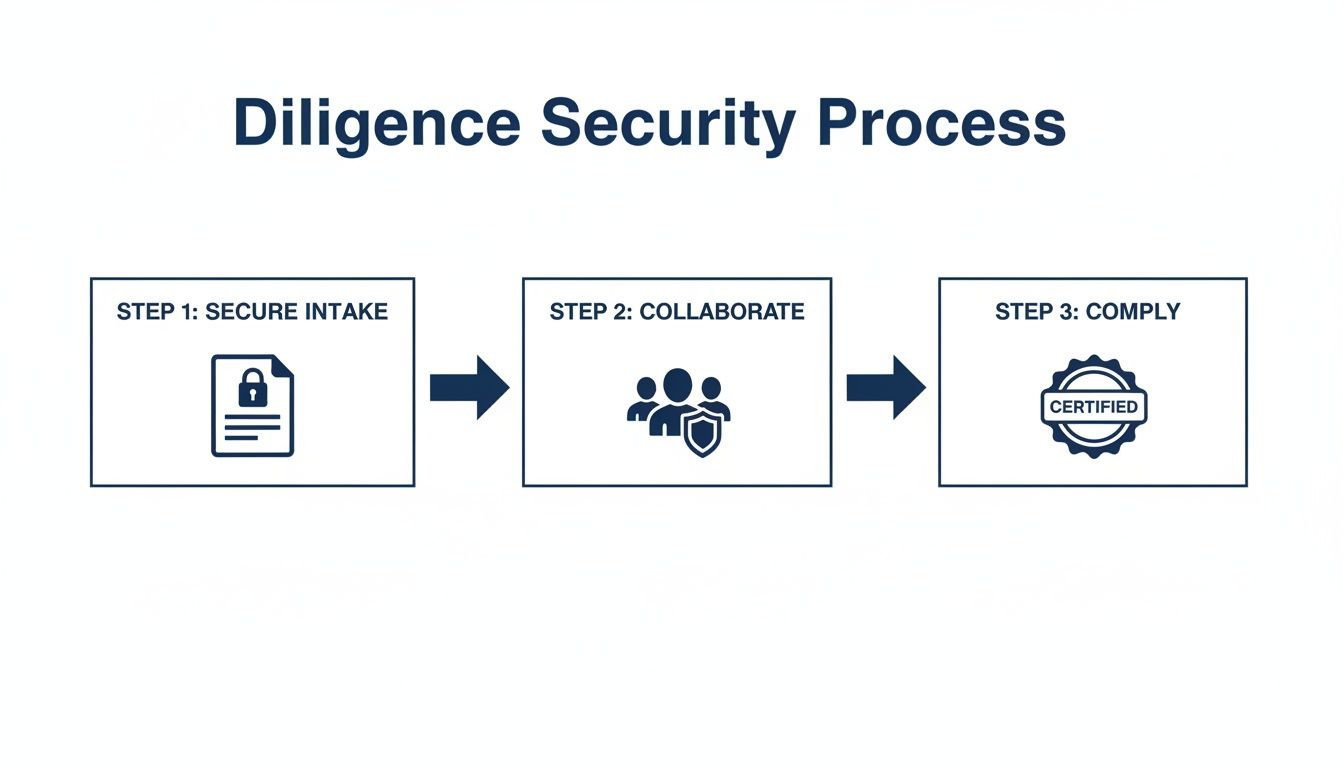
The image above maps out the essential workflow your solution must handle: secure intake, protected collaboration, and provable compliance. It’s a great visual reminder that a good implementation has to secure the entire lifecycle of sensitive information, from the moment it arrives to its final, archived state.
Evaluating and Onboarding a Vendor
Once you have a firm grasp of your risks, it's time to find the right partner. A great way to do this objectively is by creating a vendor scorecard. This simple tool helps you stack up different platforms against your specific needs, like their encryption methods, data residency options, and compliance certifications.
Here’s a practical framework to get you started:
- Define Key Criteria: Make a list of your absolute must-haves. This could be anything from HIPAA compliance to Swiss data hosting.
- Assign Weights: Not all features are created equal. Decide which ones are most critical and give them a higher weight. For instance, robust audit trails might be far more important to you than the slickness of the user interface.
- Score Each Vendor: Go through your list and rate each solution, maybe on a simple scale of 1 to 5, for every single criterion.
- Calculate the Results: Just add up the scores. This gives you a clear, data-driven picture of which vendor is the best fit, taking personal bias out of the equation.
It’s also helpful to see where technology fits into the bigger picture. Platforms like Whisperit are powerful tech solutions, but they often work best alongside security services, which handle the human element and incident response. The strongest strategies blend both—combining sophisticated software with expert human oversight. For a deeper look, you can explore this analysis of the security services market and its role in a complete security posture.
Fostering a Culture of Security
A new tool is only as good as the people using it. That’s why the final—and arguably most important—step is employee training and adoption. A smooth rollout hinges on your team understanding not just how to use the new platform, but why it's so critical for the business.
A common mistake is treating implementation as a purely technical task. True security is achieved when technology, clear policies, and an educated team work in unison. Your goal is to build a resilient security posture, not just install software.
To get everyone on board, especially partners and senior staff, frame the investment as a competitive advantage. It's a powerful way to win and keep clients who won’t settle for anything less than the highest level of data protection. This all-in approach ensures your new solution doesn't just get used—it becomes a core part of a stronger, more secure organization.
Common Questions About Diligence Security
Diving into the world of high-stakes data protection always brings up a lot of questions. When you're looking at different diligence security solutions, you need straightforward, practical answers, not a bunch of tech jargon. Here are some of the most common things we hear from legal and healthcare pros, broken down to help you make a smart, confident decision.
Differentiating Diligence Security from General Cybersecurity
How is a diligence security platform actually different from the standard cybersecurity software we already have?
It’s a great question, and an analogy helps here. Think of your firm's general cybersecurity—like your network firewall or antivirus software—as the security guards and locked doors of your office building. They do a solid job of protecting the perimeter from everyday threats.
A diligence security solution, on the other hand, is the specialized, access-controlled vault inside that building. It’s purpose-built to safeguard your most valuable and sensitive assets during a specific project.
These platforms are designed specifically for high-risk work like M&A deals, clinical trials, or contentious litigation. They bring specialized capabilities to the table that you just won't find in general-purpose tools:
- Granular file-level controls that let you decide exactly who sees what, down to the individual document.
- Detailed, unchangeable audit trails that prove compliance and log every single interaction with the data.
- Secure collaboration spaces designed for sharing sensitive information with outside parties without ever losing control.
You absolutely need both. But for the high-stakes work, diligence security provides the focused, verifiable protection that regulations demand and clients expect.
Implementing Security Without a Dedicated IT Team
Can we realistically set up and manage these solutions if we don't have a big, in-house IT security department?
Yes, you absolutely can. This is where modern cloud-based platforms, often called Software-as-a-Service (SaaS), have been a game-changer. They make top-tier, enterprise-grade security accessible to firms of any size.
The provider handles all the complex backend infrastructure for you—the server maintenance, security patches, and threat monitoring. This shifts your focus from managing hardware and software to managing people and policies. Your team can concentrate on setting user permissions, defining rules for handling data, and making sure everyone follows best practices, all through a simple, intuitive dashboard. It’s security for the rest of us.
Identifying the Most Critical Platform Feature
When choosing a secure platform, what’s the one thing we should focus on the most?
While things like encryption and access controls are non-negotiable, the single most critical factor is verifiability. In other words, can the platform give you undeniable proof that you are meeting your security and compliance obligations? The key to this is a comprehensive, immutable audit trail.
An effective platform lets you see instantly who accessed a file, when they did it, and what they did with it. This verifiable log is your best defense in a client dispute, regulatory inquiry, or internal audit. It turns security from an abstract promise into a demonstrable fact.
Always ask potential vendors how their platform helps you prove your compliance. This proof is also a central piece of any serious vendor evaluation. To learn more, check out our guide on how to build a vendor security assessment questionnaire and make sure you're asking all the right questions.
Understanding How AI Affects Security
How do artificial intelligence features play into the security of a diligence solution?
AI can be a fantastic tool for getting work done faster, but it has to operate within a security framework that is strict and non-negotiable. A securely designed AI, like the one built into Whisperit, processes your data entirely within the platform's encrypted environment. Most importantly, it never uses your confidential information to train third-party models.
The AI should also automatically inherit all the existing security permissions you’ve set. For example, if a user doesn't have the rights to view a certain document, the AI shouldn’t be able to summarize it for them. Simple as that.
When you're looking at any platform with AI, be sure to ask these critical questions:
- Where is my data actually being processed?
- Is my data kept completely private and separate from outside AI models?
- Does the AI fully respect the user access controls I’ve put in place?
The goal is to use AI to speed things up, but never at the expense of the security or confidentiality of the data you’re trusted to protect.
Ready to see how a purpose-built, secure AI workspace can transform your high-stakes legal work? Discover Whisperit, where advanced security and powerful productivity tools come together in a single, intuitive platform. Explore what Whisperit can do for your firm at https://whisperit.ai.