
GDPR Data Retention Requirements a Practical Guide
At the heart of GDPR's approach to data retention is a simple, yet powerful rule: you can't keep personal data forever. The regulation is crystal clear that data should not be held for any longer than is absolutely necessary to fulfil the specific reason it was collected in the first place. This is known as the storage limitation principle.
Understanding GDPR’s Storage Limitation Principle

Think of it like this: personal data is like milk in your fridge. You buy it with a purpose—for your cereal, your coffee, or a recipe. Once you've used it, or once it passes its expiration date, you get rid of it. You wouldn't keep sour milk around "just in case." It takes up space and becomes a health hazard.
The GDPR sees old, unnecessary personal data in the same light. It's not just digital clutter; it's a growing privacy risk. The longer you hold it, the more likely it is to be misused, breached, or become inaccurate.
This entire concept is laid out in Article 5 of the GDPR. It states that data must be kept in a form which permits identification of data subjects for no longer than is necessary for the purposes for which the personal data are processed. In short, every bit of personal data you handle needs a clearly defined shelf life.
The Crucial Link to Purpose
That "shelf life" isn't just a random date you pick out of a hat. It's tied directly to another core GDPR principle: purpose limitation. This rule says you have to collect data for "specified, explicit, and legitimate purposes."
The storage limitation principle is the natural next step. Once you've fulfilled that original, stated purpose, your justification for holding onto the data simply evaporates.
For example, if you collect a customer's address to ship an order, that purpose is fulfilled once the package is successfully delivered. You might argue that you need to keep it for a reasonable period to handle returns or warranty claims, and that's a valid secondary purpose. But you can't just keep that address for five years on the off-chance you might want to send them a catalog someday. That's a new purpose, and it would require new consent.
The storage limitation principle is designed to dismantle the old "hoard everything forever" data culture. It forces a shift to a much more deliberate and accountable mindset: collect with purpose, and retain with justification.
Justifying Your Retention Periods
While the GDPR is firm on the principle, it doesn't hand you a one-size-fits-all schedule. You won't find a line in the regulation that says, "delete customer service emails after 2 years."
Instead, the responsibility falls squarely on your shoulders to define, document, and—most importantly—justify your own retention periods for every type of data you process.
This means your organization has to do its homework:
- Define the purpose: Get crystal clear on why you are collecting and using each category of personal data.
- Check for legal holds: Are there other laws, like tax or employment regulations, that legally require you to keep certain data for a minimum amount of time? These obligations often override the basic purpose limitation.
- Create a formal policy: Based on your purposes and legal obligations, build and document a clear data retention schedule.
This proactive data governance is a cornerstone of compliance. For instance, customer support records might be kept for two years to handle any lingering issues, but after that, they must be securely destroyed. You can see more real-world examples of this principle in action on Cookieyes.com.
Building this kind of thoughtful approach into your processes from day one is what it's all about. To get a better handle on this strategy, have a look at our guide on Privacy by Design principles. Truly understanding the "why" behind your data collection is the essential first step before you can ever decide on the "how long."
Setting Practical Data Retention Periods by Category

Knowing the "storage limitation" principle is one thing, but actually putting it into practice is where the real work begins. The question every business has to answer is: how long is truly necessary? The GDPR doesn't hand you a universal timetable. Instead, it expects you to create and justify your own retention schedule based on your specific business needs and legal obligations.
Think of your data as having an expiration date. Your Human Resources team handles information with a completely different lifecycle and set of legal rules than your Marketing team does. A one-size-fits-all approach to data retention just won't cut it.
To get a handle on GDPR data retention requirements, you have to break your data down into categories and assign a specific, justifiable retention period to each one. This is how you turn an abstract legal principle into a concrete, day-to-day operational plan.
Human Resources Data
Employee records are a perfect example of how other laws shape your retention periods. You can't just hit "delete" on an employee's file the day they walk out the door. All sorts of legal and statutory rules require you to hang onto that information for a set amount of time.
- Recruitment Data: For candidates who didn't get the job, their data should be deleted soon after the position is filled—typically within 6 months. This gives you enough time to handle any potential discrimination claims. If you want to keep their resume on file for future openings, you absolutely need their explicit consent.
- Employee Contracts and Payroll: This is where national labor and tax laws really come into play. Many countries require you to keep payroll, tax, and pension records for 6 to 7 years after an employee leaves.
- Performance and Disciplinary Records: As a general rule, these should be kept for the duration of employment plus a little while after, usually aligning with the statute of limitations for legal claims in your region.
Sales and Customer Data
The data you collect from sales and customer interactions is directly tied to your contracts and relationships. The retention period here is often linked to the lifecycle of whatever product or service you're selling.
For instance, you have to keep customer purchase histories and invoices to manage warranties, process returns, and handle any disputes that might pop up. Tax authorities also demand that you keep financial records, like invoices, for several years—often around 6-7 years. But once all those contractual and legal clocks have run out, the data's original purpose is gone, and it needs to be securely deleted.
Marketing and Prospect Data
Marketing data is a bit different because it’s often based on consent or legitimate interest, which makes its retention period more fluid. You can't just hold onto someone's email address forever because they downloaded a whitepaper three years ago.
The key idea for marketing data is ongoing relevance. If a contact hasn't opened an email or clicked a link for a long time (say, 12-24 months), your legitimate interest in keeping their data starts to fade. At that point, it’s time to either ask for fresh consent or clean them off your list.
This is where a clear policy becomes your best friend. The first step is to categorize your data properly so you can apply the right rules to the right information. You can get a head start on this by reviewing a well-structured data classification policy template.
Creating a Data Retention Schedule
So, how do you keep track of all this? You create a data retention schedule. Documenting these retention periods isn't just a good idea—it's a non-negotiable part of GDPR accountability. This schedule is your proof that you’ve thoughtfully considered why you’re keeping every piece of personal data you hold.
A clear, organized table is the best way to map this out. It turns your policies into a practical guide your team can actually use.
Here's a look at what a basic retention schedule might include. Think of it as a starting point you can adapt for your own business.
Example GDPR Data Retention Periods
| Data Category | Example Data | Typical Retention Period | Justification (Legal Basis) |
|---|---|---|---|
| Human Resources | CVs of unsuccessful applicants | 6 months post-recruitment | Defend against potential legal claims |
| Human Resources | Employee contracts, payroll | 7 years post-employment | Compliance with national tax and labor laws |
| Sales | Customer invoices, order history | 7 years after transaction | Tax law compliance, handling warranty claims |
| Customer Service | Support tickets, email queries | 2 years after resolution | Resolving follow-up issues, quality assurance |
| Marketing | Prospect email addresses (no activity) | 18 months after last engagement | Legitimate interest, consent validity |
| Website Analytics | Anonymized IP addresses, usage data | 26 months | Statistical analysis, improving user experience |
By documenting these timelines and the reasons behind them, you’re not just checking a compliance box. You’re building a transparent and defensible data management strategy that respects user privacy and protects your organization.
The Real Cost of Non-Compliance
It’s easy to think of GDPR data retention requirements as just another box to tick on a compliance list. But ignoring them is a serious gamble, one that carries very real financial and reputational risks. We often hear about the maximum theoretical penalties, but the truth is, regulators are no longer just issuing warnings. They are actively enforcing these rules, and the consequences are hitting businesses hard.
Forgetting to implement and stick to a data retention schedule isn't a minor slip-up. To a regulator, it signals a fundamental failure in how you govern data. It suggests you're being careless with personal information, which often triggers deeper, more painful scrutiny during an audit or a data breach investigation. The fines aren't just for show; they're designed to hurt and send a clear message to everyone else.
The Escalating Financial Penalties
If you look at the trend in GDPR enforcement, it's impossible to miss: the fines are getting bigger and more common. Regulators have moved past the initial grace period. Now, they’re handing out significant penalties that make headlines and rattle shareholders. The era of excuses is over.
By January 2025, the total fines handed out under GDPR had climbed to a staggering €5.88 billion. That number alone should tell you how seriously European authorities take data protection. Just look at Meta, which was hit with a €1.2 billion fine in 2023 for a range of issues, including how it handled data retention and transfers. The average cost of a GDPR violation has also skyrocketed, jumping from about €500,000 in 2019 to €4.4 million in 2023. You can explore more about the biggest GDPR penalties and their implications in this detailed analysis.
Beyond the Fines: Reputational Damage
As eye-watering as the fines are, the damage often runs much deeper. Trust is a currency, and it's incredibly fragile. A major GDPR penalty is a public declaration that you might not be a safe guardian of your customers' data.
This loss of faith can haunt a business for years:
- Customer Churn: People will leave. They’ll take their business to a competitor they feel they can trust more.
- Negative Press: A big fine is big news. The resulting media storm can tarnish your brand's image overnight.
- Difficulty Attracting New Business: Potential clients and partners will think twice before working with a company that has a public record of data protection failures.
A GDPR fine is not just a one-time cost. It's an event that can erode brand equity, complicate sales cycles, and create a lasting perception of unreliability in the marketplace.
The Operational Burden of an Investigation
Dealing with a regulatory investigation is a massive drain on resources. It pulls your key people—from the legal department and IT team right up to the C-suite—away from their actual jobs. The whole process is an ordeal of endless documentation requests, interviews, and audits that eats up time and creates a ton of internal stress.
And after the fine comes the cleanup. Proving you've fixed the problem requires a serious investment. You might have to completely overhaul your internal processes, bring in new technology, and retrain your entire staff. These aren’t simple fixes; they are major operational and financial undertakings. To stay ahead of these problems, you need a solid foundation, which you can build using our ultimate GDPR compliance checklist for data protection success.
How to Build a Compliant Data Retention Policy
Understanding the theory behind GDPR data retention requirements is one thing, but actually building a policy that puts those principles into practice is what really counts. A solid data retention policy isn't just another document gathering dust on a server; it's the operational blueprint that guides your entire organization on how to handle personal data responsibly. Think of it as your single source of truth for proving you're accountable to regulators.
Putting this policy together isn't guesswork. It's a methodical process: mapping your data, understanding why you have it, deciding how long you'll keep it, and planning for its final, secure disposal. You're essentially creating a lifecycle manual for every piece of personal information your business touches.
The whole point is to create a framework that's both logical and defensible. If you're ever questioned, you can point to it and explain your reasoning. The stakes are high—as the chart below shows, a simple compliance failure can escalate quickly.
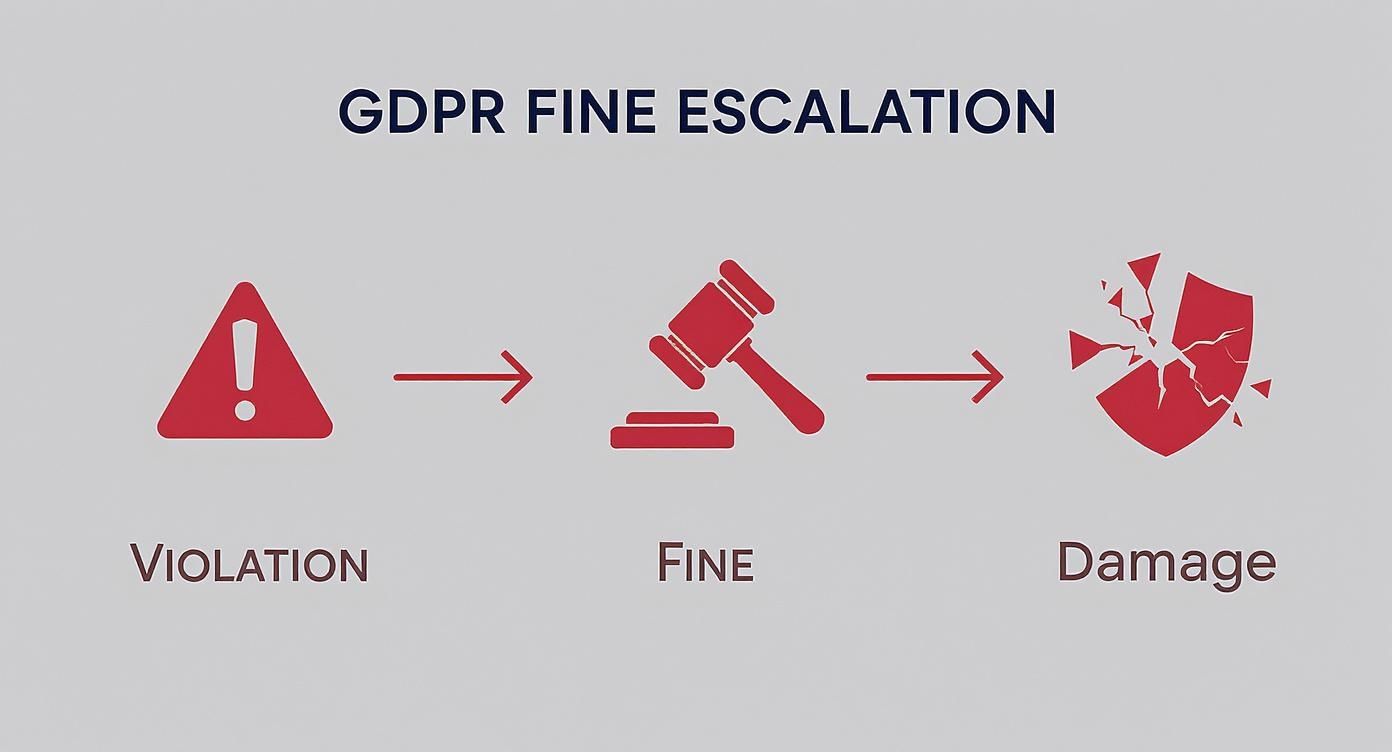
As you can see, what starts as a violation can rapidly spiral into serious financial penalties and lasting reputational damage. A robust policy is your best line of defense.
Step 1: Conduct a Thorough Data Inventory
You can't protect what you don't know you have. Simple as that. The first real step is a full-blown data mapping exercise. This means rolling up your sleeves and identifying every single type of personal data your organization collects, processes, and stores.
Your inventory needs to answer a few critical questions for each data category:
- What data are we actually collecting? (e.g., names, emails, IP addresses, health records)
- Where is it all stored? (e.g., CRM system, cloud servers, local drives, even old-school paper files)
- Who can get their hands on it? (e.g., the marketing team, HR, third-party contractors)
- How are we protecting it? (e.g., encryption, access controls)
This initial audit is the bedrock of your entire policy. Trying to build a policy without it is like flying blind.
Step 2: Define the Purpose for Each Data Category
Okay, so you know what data you have. Now you need to tie it back to the GDPR's "purpose limitation" principle. For every piece of data you identified in your inventory, you must clearly document why you have it in the first place.
Are you using it to fulfill a customer contract? Did you get explicit consent for marketing emails? Or is there a legal reason, like holding onto employee tax records for a certain number of years? This step is absolutely non-negotiable because the purpose is what directly justifies how long you can keep the data.
A data retention policy without clearly defined purposes is like a ship without a rudder. It lacks direction and cannot be steered through the complexities of GDPR compliance, leaving the organization exposed to significant risks.
Step 3: Research Legal Requirements and Set Retention Periods
With your data mapped out and its purpose clear, you can finally start setting concrete retention periods. This is where your internal business needs meet external legal and regulatory rules.
For some types of data, like financial invoices or employee files, the law will spell out a minimum retention period for you. For others, such as marketing data, you’ll have to define a reasonable period based on your legitimate interest and how engaged your audience is. The key is that every single retention period must be justifiable.
Document all of this in a clear, easy-to-read retention schedule. This schedule will become the heart of your policy, detailing the data type, its purpose, the legal basis for processing, the retention period, and what happens when time is up.
Step 4: Establish Secure Deletion Protocols
Your policy must also spell out exactly what happens when data reaches the end of its life. Just dragging a file to the trash bin on a computer isn't going to cut it. Secure deletion means making absolutely sure that the data is gone for good and can't be recovered.
This means creating clear procedures for different kinds of storage media:
- Digital Data: Specify the methods you'll use, like cryptographic erasure or specialized data destruction software.
- Physical Data: Outline procedures for shredding paper documents or physically destroying old hard drives.
A truly robust policy doesn't just stop at deletion; it requires proof. This is where things like obtaining a certificate of destruction for hard drives come in. That documentation is your evidence, proving you did what you said you would if an auditor ever comes knocking. For those looking for a complete framework, our guide on data retention policy templates is a fantastic starting point for building your own document.
Navigating Exceptions and Legal Holds
Think of your data retention schedule as the bedrock of your compliance strategy. But what happens when you have to break your own rules? In the real world, things get complicated. You might find yourself facing litigation, a government investigation, or another legal challenge where you’re legally required to pause your own deletion policies.
These situations are all about navigating exceptions to the standard GDPR data retention requirements with absolute precision. It’s like a train conductor holding a departure for a critical reason; you need to know exactly when to place a "hold" on certain data, overriding its scheduled deletion date.
This process has a formal name: a legal hold (or litigation hold). It’s an official directive, usually from your legal counsel, to preserve every piece of information that could be relevant to an anticipated lawsuit. Messing this up can lead to serious penalties for destroying evidence, which can be just as disastrous as the lawsuit itself.
Understanding and Implementing a Legal Hold
When a legal hold notice lands on your desk, it’s an immediate stop sign for your normal data destruction routines. All data connected to the case—emails, documents, database entries, team chat logs—must be cordoned off and protected from any deletion or changes. This is non-negotiable for maintaining the integrity of potential evidence.
Putting a hold into practice correctly involves a few critical steps:
- Identify Relevant Data: Your first move is to work with your legal team to figure out exactly whose data (the "custodians") and what systems are involved.
- Issue a Clear Notice: You need to send a formal, written hold notice to every relevant employee, clearly explaining their duty to preserve the specified information.
- Suspend Automated Deletion: This is where your IT team steps in. They have to halt any automated processes that might otherwise delete the data in question. Often, this means moving the data to a secure, separate archive.
- Document Everything: Keep a detailed paper trail of who was notified, when the hold was put in place, what it covers, and every action taken to secure the data.
A legal hold isn't a friendly suggestion; it's a binding legal obligation. It effectively freezes the data lifecycle, ensuring that information vital to a legal case is kept safe until the matter is officially closed and the legal team gives the all-clear.
Your documentation is your best defense. It's your proof that you acted responsibly to preserve evidence. Only when the legal matter is fully resolved will your lawyers issue a formal release, allowing you to finally apply your normal retention and deletion schedules to that data.
Other Justifiable Reasons for Extended Retention
While legal holds are the most common exception, the GDPR does allow you to keep data longer for other specific reasons. These aren't loopholes for holding onto data forever; they are tightly controlled exceptions that typically serve the public interest.
These other exceptions often cover:
- Archiving in the Public Interest: Think of national archives or libraries that need to preserve data for the historical record.
- Scientific or Historical Research: Researchers might need to retain datasets for years to conduct long-term studies, like tracking public health outcomes.
- Statistical Purposes: Organizations may keep anonymized data to perform statistical analyses that provide broad societal benefits.
But there’s a big string attached. If you plan to use one of these exceptions, you must implement robust safeguards to protect people's privacy. The go-to method here is pseudonymization, which means replacing direct personal identifiers with artificial codes. This makes it incredibly difficult to trace the data back to an individual without a separate key, striking that crucial balance between data utility and personal privacy.
Adapting to Regulatory Changes for Small Businesses
The world of data protection is anything but static. For small and medium-sized businesses (SMEs), staying on top of the constant shifts is a real challenge. While the core ideas behind GDPR aren't going anywhere, regulators are starting to realize that a one-size-fits-all rulebook can bury smaller organizations in paperwork.
This has led to a welcome new focus on simplification. Smart SMEs are starting to see compliance less as a fixed checklist and more as a continuous process. Keeping an ear to the ground for proposed changes means you can be proactive, shaping your data retention strategy for what's coming next instead of scrambling to react when new rules are already law.
A Focus on Proportionality for SMEs
A big part of this evolution is the push to make compliance proportional to risk. Everyone gets that the resources of a local shop are worlds apart from those of a multinational giant, and the rules are starting to reflect that reality.
Recent regulatory talks in 2025 have zeroed in on simplifying GDPR, especially around data retention for SMEs. The European Commission has put forward ideas to amend the GDPR, suggesting that certain exemptions under Article 30(5) could be extended to organizations with fewer than 750 employees, provided their data activities don't create a high risk for people. You can find the full details of these proposed simplifications for record-keeping online. The goal here is to lighten the administrative load without weakening data protection itself.
This potential tweak to Article 30(5) is a perfect example of this new thinking. Right now, the break from keeping detailed Records of Processing Activities (ROPA) is mostly for businesses with under 250 employees. This new proposal could open that up to a much larger group of companies.
This signals a more pragmatic approach from regulators. They're focusing enforcement on high-risk data processing while making the compliance journey smoother for lower-risk SMEs. It’s a move from rigid, one-size-fits-all rules to a more sensible, risk-based accountability.
What This Means for Your Business
For an SME that fits the bill, these changes could have a direct, positive impact on your GDPR data retention requirements. A lighter record-keeping burden means less time buried in exhaustive documentation and more time spent actually running your business. It could make managing and justifying your data retention schedules far simpler, as long as your operations stay low-risk.
But let's be clear: this isn't a free pass to forget about data protection. The core responsibilities are still very much in place:
- Storage Limitation: You absolutely still need to define—and be able to justify—how long you keep every piece of personal data.
- Data Security: Putting the right security measures in place to protect that data is completely non-negotiable.
- Data Subject Rights: You must continue to honor people's requests to see, correct, or delete their information.
Handling these duties effectively, even with simpler rules, requires a solid organizational system. Getting a handle on document management for small business is crucial for staying compliant without losing your mind. By keeping one step ahead of the regulatory curve, small businesses can build strategies that are both compliant and practical.
Common Questions About GDPR Data Retention
Even with a rock-solid policy, the day-to-day reality of handling data throws up some tricky questions. When you're trying to apply the principles of GDPR data retention to real-world situations, it's easy to get stuck. Let's walk through a few of the most common scenarios that businesses run into.
Think of this as a quick-reference guide to help your team navigate those grey areas and stay on the right side of compliance.
How Do We Handle Deletion Requests for Data We Must Legally Keep?
This is a classic GDPR dilemma: what happens when someone's "right to be forgotten" clashes with your own legal obligations? The answer, thankfully, is pretty clear: legal requirements almost always win.
For instance, if a former employee asks you to wipe their payroll records, but tax law demands you keep them for seven years, you are legally obligated to deny the request for that specific data.
The key is transparency. You can't just ignore the request. You need to respond and explain:
- Why you're keeping the data (e.g., to comply with specific tax laws).
- Exactly what information you're retaining and for how long.
- That you have deleted any other data you aren't legally required to hold.
What About Data in Archived Backups?
Backups are a real headache for data retention. You might have scrubbed your live systems clean, but that same data can be lurking in archived backups for years. The regulators understand that it's often not feasible or practical to instantly erase a single piece of information from a complex backup system.
The accepted best practice is to put the data "beyond use." This means the backup is securely stored, encrypted, and isolated so it can't be used for any day-to-day business. When the backup media itself reaches the end of its lifecycle, the data is then destroyed permanently along with it. Make sure you document this entire process in your retention policy.
Does the Retention Period Depend on the Legal Basis?
Yes, absolutely. The legal basis you rely on to process data is directly tied to how long you should keep it. It's not a one-size-fits-all situation.
Here’s how it breaks down:
- Consent: If you have someone's consent, you should delete their data as soon as they withdraw it. If they don't withdraw it, you should still get rid of it after a reasonable amount of time passes and they're no longer engaged.
- Contractual Necessity: You can keep data for the life of the contract, but also for a period afterward. This gives you a window to handle any potential disputes, claims, or final accounting.
- Legitimate Interest: This one is more of a balancing act. You have to periodically ask yourself, "Does my business interest in keeping this data still outweigh this person's privacy rights?" If the answer is no, it's time to delete.
Getting a handle on how these justifications shape your data timelines is fundamental to a compliant retention strategy.
At Whisperit, we know just how complex legal documentation and compliance can be. Our voice-first AI workspace is built with GDPR-aligned controls and secure Swiss/EU hosting options, giving legal teams the confidence to manage sensitive data. Discover how Whisperit can bring clarity and efficiency to your workflow.