
How to Draft a Legal Memo That Gets Results
A legal memo isn't just a document; it's a structured analysis of a legal issue. At its heart, it’s about answering a question clearly by stating the law, applying it to the facts of your case, and reaching a solid conclusion. This logical flow, often following a framework like IRAC (Issue, Rule, Application, Conclusion), is what makes your analysis persuasive and easy for a senior attorney to digest.
2. Nail the Structure: The Blueprint of Your Memo

Before you even start writing, you have to get your head around the memo's real job. It's not an academic paper or a place for creative arguments. It's a critical decision-making tool. Its main purpose is to give an objective, unvarnished analysis of a legal question to inform your supervising attorney or a client about the likely outcome of a case.
Think of yourself as a strategist laying out the battlefield. You're creating an internal roadmap that predicts how a court will likely rule on an issue by digging deep into statutes and case law. This objective, predictive tone is what makes a memo different from a persuasive brief, where your goal is to advocate for one side.
Choosing Your Analytical Framework
The structure is the skeleton that holds your legal argument together. Without a strong one, even the most brilliant analysis can fall flat. A disorganized memo just creates confusion. That's why experienced legal professionals lean on established frameworks to keep their writing sharp and clear.
You’ve probably heard of the most common ones:
- IRAC (Issue, Rule, Application, Conclusion)
- CRAC (Conclusion, Rule, Application, Conclusion)
- CREAC (Conclusion, Rule, Explanation, Application, Conclusion)
While IRAC is the classic taught in law school, you'll find that in practice, many attorneys prefer starting with the answer. CRAC and CREAC put the conclusion right at the top—a "bottom line up front" approach that busy partners and clients really appreciate. They need to get the main takeaway immediately.
To help you decide, here’s a quick look at how these frameworks stack up.
Common Legal Memo Structures at a Glance
This table offers a quick comparison of the most widely used frameworks for organizing legal analysis in a memo.
| Structure | Acronym Breakdown | Best Used For |
|---|---|---|
| IRAC | Issue, Rule, Application, Conclusion | Academic settings and straightforward analyses where the question is the primary focus. |
| CRAC | Conclusion, Rule, Application, Conclusion | Professional practice where the reader needs the main takeaway immediately before the reasoning. |
| CREAC | Conclusion, Rule, Explanation, Application, Conclusion | Complex issues requiring a detailed explanation of the legal rule before applying it to the facts. |
When in doubt, leading with your conclusion (CRAC/CREAC) is almost always a safe bet in a professional setting. It shows you respect the reader's time and makes your analysis feel more direct and impactful. Of course, always check if your firm or supervisor has a preferred format.
How the Digital Shift Is Changing the Game
The way we write and share memos has changed dramatically. The core purpose is the same, but the medium is often different. A recent study shows that while 54% of legal pros still draft up to five traditional paper memos a year, a huge 35% are now creating over 20 e-memos annually.
This shift means the formal, printed memo isn't dead, but its digital twin is everywhere. Today's memo is often a rapid-response document—an email or a shared file—that demands speed without sacrificing analytical rigor.
This new reality makes efficient drafting more critical than ever. As we explore how to write legal documents in this fast-paced world, it's clear that the foundational principles of clear structure and objective analysis are what allow us to deliver quality work under pressure.
Building Your Research and Outlining Strategy
Every great legal memo starts long before you write the first sentence. Its strength—its very persuasiveness—is forged in the research phase. A well-written memo is good, but one built on a bedrock of on-point statutes, binding case law, and compelling persuasive authority is what actually wins arguments. This is where you turn a vague legal question into a razor-sharp research plan.
Your first job is to cut through the noise. You need to get from a broad query to the specific legal principles that control the outcome, and you need to do it without drowning in information. Start by pulling key search terms from your fact pattern. From there, I always like to begin with secondary sources—think legal encyclopedias, treatises, and law review articles. They give you the lay of the land, helping you understand the contours of a legal doctrine before pointing you to the primary authorities that really matter.
From Information Gathering to a Cohesive Outline
With a general understanding of the legal landscape, it's time to get your hands dirty with primary sources. This means digging into the statutes in your jurisdiction and, crucially, the case law. Your mission is to find cases that are not just legally relevant but factually similar to your client’s situation. This is where the real work begins. A case might seem perfect on the surface, but a subtle factual difference can make it completely useless for your argument.
As you start finding these gems, you absolutely need a system to keep everything straight. Trust me, trying to manage this with a dozen browser tabs and a messy Word doc is a recipe for disaster.
- Group by Issue: Organize your research materials based on the specific legal questions they answer.
- Track Your Authorities: Keep a running log of your key cases. Make a clear note of which ones are binding and which are merely persuasive.
- Pull Key Language: When you find a perfect quote stating a legal rule, copy it immediately. You'll thank yourself later.
This is exactly why we built the 'Cases' feature in Whisperit. It functions as a central hub for each matter, giving you one place to keep research files, notes, and key authorities organized. It's about having everything you need in one place instead of scattered across your desktop.
Structuring Your Argument Before You Write
Once your research is organized, you can build your outline. This isn't just a simple list of topics; it's the blueprint for your entire argument, and it should follow your chosen structure, whether that's IRAC, CRAC, or something else. For each issue, your outline needs to sketch out the rule you'll use, the specific facts you'll apply, and what your initial conclusion is.
A solid outline does more than just keep you organized. It's a stress test for your logic. It will expose any gaps in your research or weak points in your analysis before you've wasted hours drafting prose that's destined for the cutting room floor.
For instance, if you're outlining the "Application" section for a simple negligence claim, you would have bullet points under each element—duty, breach, causation, damages—listing the specific facts from your case that you'll use to prove (or disprove) it. This methodical approach ensures nothing falls through the cracks.
For those dealing with particularly complex matters, specialized Legal Data Integration and Reporting Services can be a huge help in managing and making sense of large volumes of information. Of course, none of this works without a firm grasp of the fundamentals, so make sure you're comfortable with different legal research methods to ensure your work is both thorough and efficient.
Putting in the effort to create a detailed research strategy and outline isn't extra work—it's the real work. It provides a clear roadmap that makes the actual writing process faster, smoother, and far more effective.
3. Drafting the Memo: From Question Presented to Conclusion
With your research organized and your outline ready, it’s time to start writing. This is where you move from gathering information to building a persuasive legal argument, piece by piece. The goal is to create a document that flows logically and makes your reasoning crystal clear.
A strong memo is built on a solid foundation. You start with the core question, do the deep-dive research, and then map out your argument with an outline.
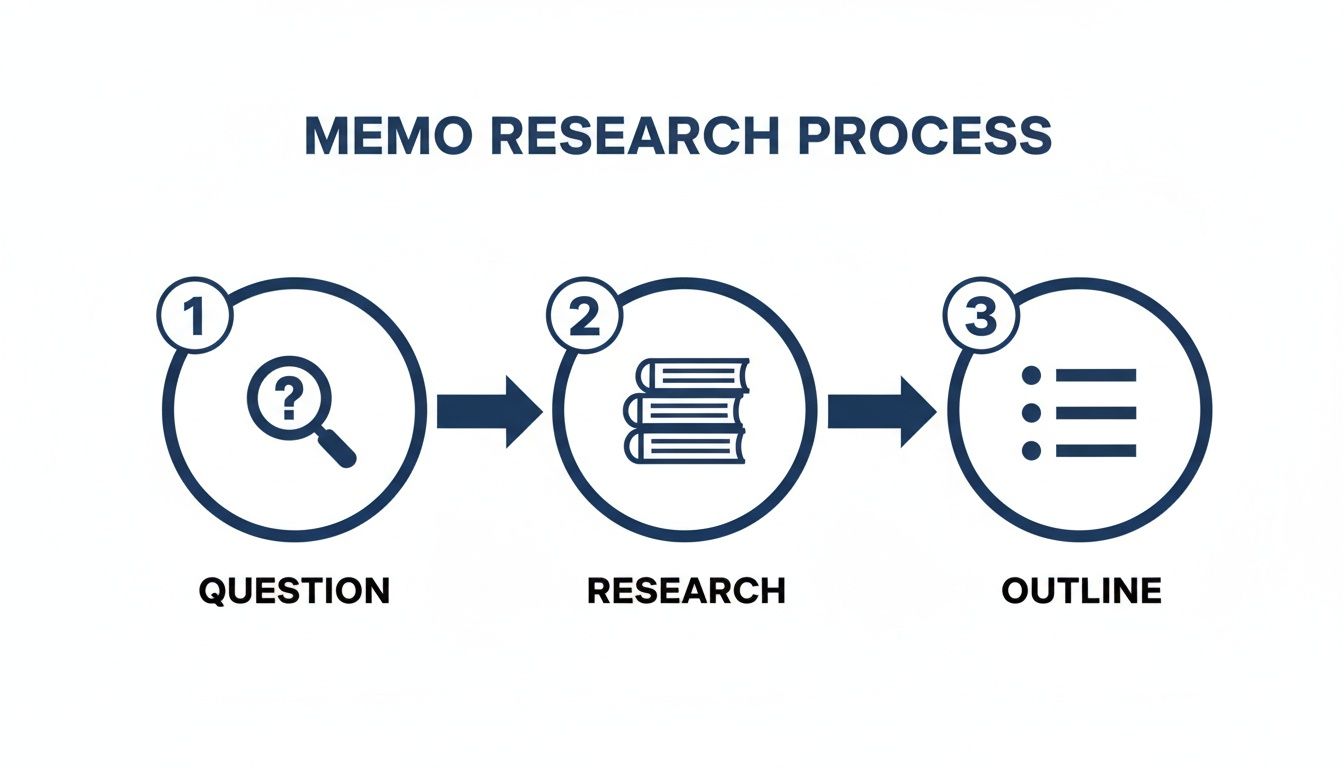
Trying to skip these early steps almost always leads to a disorganized and unconvincing memo. Trust the process; the upfront work pays off.
Crafting a Precise Question Presented and Brief Answer
Think of these first two sections as the front door to your memo. They're the first thing a busy partner or client will read, and they need to be perfectly clear and concise.
The Question Presented (sometimes just called the "Issue") should be a single, sharp sentence that frames the entire legal problem. The best ones seamlessly weave the controlling law with the most important facts of your case. A weak question is generic; a great one is a roadmap for the entire analysis.
For instance, a vague question like, "Is the government liable for negligence?" doesn't help much.
A much stronger version would be: "Under the Federal Tort Claims Act, is the U.S. government liable for negligence when two on-duty but intoxicated Park Rangers removed bear warning signs 3 days before replacements were installed, leading to a visitor's injury?"
This version works because it names the specific statute and pinpoints the critical facts that will drive the analysis—the rangers' employment status, their specific actions, and the direct consequence.
Right after the question comes the Brief Answer. Start with a direct "yes" or "no," then follow it with a one- or two-sentence summary of your reasoning. It’s the executive summary of your memo, giving the reader the bottom line right away.
Building the Discussion: The Heart of the Memo
The Discussion is where you do the heavy lifting. Using your chosen structure (IRAC, CRAC, etc.), this is where you meticulously apply the law to the facts of your client's situation. You should tackle each issue or sub-issue you identified in your outline one by one.
For every issue, follow a methodical path:
- State the Rule: Lay out the relevant legal rule, citing the statute or case law it comes from. Every legal principle needs a citation.
- Explain the Rule: If a rule is nuanced or has a complex history, you might need a brief explanation (the 'E' in CREAC) of how courts have interpreted it.
- Apply the Facts: This is the most crucial part. You have to explicitly connect the rule to your specific facts. Don't just list the law and then list the facts—weave them together to show why the rule leads to a certain conclusion in this case.
- Conclude: Briefly state the likely outcome for that specific issue based on your application.
This structured approach forces you to build a logical bridge between the law and your client's reality, which is the entire point of legal analysis.
Pro Tip: Use headings and subheadings liberally in the Discussion section to match your outline. If you're analyzing a negligence claim with four elements (duty, breach, causation, damages), give each element its own subheading. This makes the document far easier for a busy reader to scan and digest.
Research has shown that supervising attorneys overwhelmingly prefer memos with detailed, explicit legal reasoning over those with short, conclusory statements. They want to see your work and understand how you reached your conclusion.
Finalizing with a Clear Conclusion
Finally, the Conclusion wraps everything up. It summarizes your analysis and provides a definitive answer to the Question Presented. You won't introduce any new arguments or facts here; you’re simply restating the key takeaways from your Discussion.
While it's similar to the Brief Answer, the Conclusion is usually a bit more fleshed out. It pulls together the mini-conclusions from each sub-issue you analyzed, leaving the reader with a confident and complete picture of the legal landscape.
Getting this structure right takes practice, but proper citation is a must from day one. To make sure yours are on point, check out our guide on legal citation examples for different formatting styles.
Editing Your Draft For Clarity And Impact
Let's be honest: your first draft is just the starting point. It's the raw clay. The real work—the part that turns a decent analysis into a truly effective legal memo—happens during the edit. This isn't just about catching typos; it's about sharpening your arguments, refining your language, and ensuring your memo has the professional punch it needs.

Think of it like a sculptor chipping away at a block of marble. You have to cut everything that isn't essential to reveal the clear, compelling argument hidden inside. This means ruthlessly cutting redundant phrases, clarifying any murky sentences, and making sure the entire document flows logically from one point to the next.
Maintaining A Professional And Objective Tone
A legal memo is an analytical tool, not a piece of advocacy. Your job is to give an unvarnished assessment of the law, which demands a neutral and professional tone. As you edit, you need to actively hunt down and remove any language that even hints at taking a side.
Be on the lookout for words that betray bias or emotion. For instance, instead of saying a party’s actions were "obviously wrong," you should let the facts and your application of the law do the talking. The analysis is far more powerful when the reader arrives at that conclusion on their own, guided by your reasoning—not your adjectives.
This is also the perfect time to check for consistency. If you refer to a statute by its full name once, stick with that convention throughout. Inconsistent terminology can create confusion and make your work seem less rigorous.
An objective memo builds trust. Your supervising attorney needs to rely on your unbiased assessment to make strategic decisions. Any hint of advocacy undermines that trust and, ultimately, the memo’s purpose.
The Self-Editing Checklist
Never hand over a draft without giving it a thorough self-edit first. This systematic pass is your best defense against the kind of common mistakes that can completely distract from your message.
Here’s a practical checklist I use to guide my own revisions:
- Clarity and Conciseness: Is every sentence as direct as possible? Have you cut legal jargon where simpler language would work better? Get rid of "throat-clearing" phrases that just add words without adding meaning.
- Logical Flow: Does each paragraph build on the last one? Try reading just your topic sentences aloud—they should form a coherent outline of your entire argument.
- Citation Perfection: Double-check every single citation. Seriously. Make sure the format is correct and, more importantly, that it points to the right authority. A single bad citation can cast doubt on all of your research.
- Proofreading for Errors: Only after the substance is solid should you do a final pass for grammar, spelling, and punctuation. A great trick is to read your draft backward, from the last sentence to the first. It forces your brain to see individual words and helps you spot errors you'd otherwise miss.
For a deeper look into this crucial final step, our collection of essential proofreading tips can help you catch even the most stubborn errors.
Streamlining Review With Collaborative Tools
Editing is rarely a solo sport. Getting a fresh pair of eyes on your work is one of the most valuable things you can do. Modern tools make this process so much easier than the old days of red pens and paper drafts.
Whisperit’s collaboration features, for example, let colleagues drop comments and suggest edits right in the document. This completely eliminates the nightmare of trying to track multiple versions sent back and forth over email.
Once you’ve incorporated all the feedback, a final consistency check is a must. This is where a feature like Whisperit's Style Profiles really shines. You can apply a pre-set profile to your memo as a final quality control step, automatically enforcing your firm’s specific rules for formatting, numbering, and citation style. It’s the perfect way to ensure every memo you produce is not only analytically sound but also perfectly polished.
Finalizing and Presenting Your Legal Memo
You’ve done the heavy lifting—the research is solid, the arguments are drafted, and you’ve edited it down. But the last mile is what often separates a good memo from a great one. Polishing your document isn't just about making it look nice; it’s a reflection of your professionalism and a courtesy to the person who has to read it. A crisp, well-formatted memo shows you’re meticulous.
Before you even think about formatting, give it one last, brutal proofread. The best trick I've learned is to step away from the memo for a few hours, or even a full day if you can. When you come back, your eyes will be fresh.
Reading your work aloud is another great technique. It forces you to slow down and helps you catch awkward phrasing or typos that your brain automatically corrects when you read silently. If a colleague has a spare 15 minutes, a second set of eyes is invaluable. This is your last line of defense against an error that could undermine all your hard work.
Standard Formatting for a Professional Finish
Every firm has its own style guide, but some formatting principles are universal. Getting these right is the foundation of a professional-looking document.
Drill down on these key elements:
- Headings and Subheadings: Create a clear visual hierarchy. Your reader should be able to skim the headings and understand the memo's structure immediately. Keep the font styles and sizes consistent for each level.
- Margins and Spacing: The standard is usually one-inch margins and double-spacing. This isn't just tradition; it gives the reader’s eyes breathing room and leaves space for handwritten notes.
- Page Numbering: It’s a small detail that causes big headaches if forgotten. Pop the page numbers in the footer and be done with it.
These details might seem minor, but together they create an authoritative document that’s easy to read and navigate.
Using Automated Layouts to Save Time
Fiddling with margins, headers, and footers for every single document is a classic time-waster. This is where you can let technology do the work for you. Instead of manually tweaking every setting, use automated export layouts to get your memo ready with a single click.
A tool like Whisperit, for instance, lets you create and save specific layouts that automatically apply your firm's presentation standards.
This image shows exactly what I mean—you can have different layouts for different needs. One click, and the right letterhead, page numbering, and formatting are instantly applied. It’s a simple way to guarantee consistency across all your work and shave off precious time when you’re on a deadline.
Securing Your Memo and Protecting Client Data
Once the memo is perfect, you have one final, non-negotiable responsibility: security. Your memo is packed with sensitive, privileged information. How you share and store it is just as critical as the legal analysis inside.
Protecting client confidentiality isn't just an IT problem; it's a core professional responsibility. A data breach from an insecurely shared document can be devastating for your client and your firm's reputation.
Your duty to protect client data doesn’t end when you save the file. When you send that memo—even to a senior partner down the hall—you have to ensure the method is secure. Attaching a confidential document to a standard email often isn't good enough. To get this right, you need to understand the best practices for encrypted document sharing. It’s the final check to ensure your diligence covers everything from the first case you pulled to the last click of the "send" button.
Common Questions On Drafting A Legal Memo
Even with a solid game plan, you're bound to hit a few snags when you're in the weeds of drafting a legal memo. Knowing how to navigate the tricky parts—like those facts you wish weren't in the record or picking the right structure for a thorny issue—is what elevates a good memo to a great one. Let's walk through some of the most common hurdles you'll face.
How Do I Choose the Right Memo Structure?
The debate between IRAC, CRAC, and CREAC can feel a bit like a law school exam question, but it has real-world consequences for how your analysis is received. The best choice really boils down to two things: who you're writing for and how messy the legal question is.
In most professional settings, for a fairly straightforward issue, CRAC (Conclusion, Rule, Application, Conclusion) is your go-to. Supervising attorneys are busy; they want the bottom line right at the top. Leading with the conclusion respects their time and makes your work immediately useful.
But what if you're wrestling with a really complex issue, or maybe a novel point of law? That's where CREAC (Conclusion, Rule, Explanation, Application, Conclusion) shines. That extra "Explanation" step is your chance to break down the nuances of the rule before you start applying it to your facts. This avoids a lot of confusion and makes your application section much cleaner and more powerful.
Think of it this way: CRAC is perfect when the rule is a given and the facts are the star of the show. CREAC is for when the rule itself needs some explanation before it can be applied effectively.
How Should I Address Facts That Hurt My Case?
It’s tempting, I know. But ignoring unfavorable facts is one of the worst mistakes you can make in a legal memo. This document is meant to be an objective, internal analysis, not a one-sided brief. Your supervisor needs to see the whole picture, warts and all, to make smart strategic calls.
The trick is to tackle these facts head-on, but to do so within your analytical framework.
- Acknowledge It: Don't bury the bad fact. Bring it up right in the "Application" section where it belongs.
- Analyze Its Impact: Show your work. Explain exactly why this fact is a problem under the relevant rule.
- Offer Counterarguments: Can you soften the blow? Look for countervailing facts or legal arguments that might diminish the negative fact's importance.
Let’s say you have a case where park rangers took down warning signs while intoxicated. That’s a tough fact. You have to address their intoxication directly by analyzing whether being drunk takes their actions outside the "scope of employment." You could then argue that because they were still on the clock and performing a task they were assigned, their actions likely remain within that scope, even with the intoxication. This kind of transparent analysis shows you're thorough and builds your credibility.
Can I Be Too Concise?
Oh, absolutely. Being concise is a wonderful skill, but it crosses the line into a weakness when it sacrifices clarity and a complete analysis. Your goal isn't just to write a short memo; it's to write one that is exactly as long as it needs to be—and not a word longer.
Your memo has to show the reader your thought process. Don’t just drop a conclusion on them; walk them through the reasoning that got you there. A memo that simply states, "The court will likely find the defendant was negligent," is pretty useless. A powerful memo, on the other hand, methodically applies the specific facts of your case to each element of negligence: duty, breach, causation, and damages.
As a practical rule of thumb, try to dedicate at least one solid paragraph to applying each key element of a legal rule to your facts. If your "Application" section feels more like a bulleted list of conclusions, you've probably cut too much meat from the bone. The reader must be able to follow your logic and understand how you arrived at your conclusion.
Ready to transform your drafting process? Whisperit is the voice-first AI workspace that unifies dictation, research, and collaboration, allowing you to move from initial thought to a polished, client-ready memo in fewer steps. See how our structured templates and automated formatting can give you more time to focus on what matters most—your legal analysis. Explore Whisperit today.