
How to improve client onboarding process: Quick Wins
When you're looking to improve your client onboarding, it's not just about creating a checklist. It's about building a structured, proactive system that sets clear expectations right away, makes the experience personal, and shows your value—fast. You're shifting from a reactive "to-do" list to laying a strategic foundation for a long-term partnership. The goal is to make clients feel confident and supported from day one.
Why a Great Onboarding Process Is Non-Negotiable

Let’s be honest: your client onboarding isn't just a welcome mat. It's the very bedrock of your entire client relationship. It can either set the stage for a long-term, profitable partnership or become the first step toward a quick, frustrating churn. A clunky, disorganized start almost guarantees a poor outcome.
Think about the real-world consequences. A confusing kickoff meeting leads to a flood of early support tickets, draining your team's resources. Misaligned expectations cause scope creep and awkward conversations down the road. I once saw a key account lost within 90 days simply because the initial setup was so muddled that the client lost all confidence before the real work even began.
This is where a proactive, relationship-focused approach makes all the difference. It's not about ticking boxes on a generic list; it's about building a system that turns new customers into loyal advocates from the moment they sign.
The Impact on Loyalty and Retention
That first impression is more powerful than you might think. Data consistently shows a direct link between a client's initial experience and their decision to stick around. In fact, research reveals that 63% of customers say the onboarding experience heavily influences their decision to buy.
And it gets even clearer: a staggering 86% of customers confirm that clear, educational, and welcoming onboarding directly contributes to their long-term loyalty. This shows that a great first impression isn't just a nice-to-have—it’s a core driver of retention.
A well-oiled process does more than just make clients happy; it directly impacts your bottom line by reducing churn and boosting lifetime value. To really nail this initial journey, it's worth digging into other essential customer onboarding best practices that modern businesses are using.
Setting the Foundation for Success
Ultimately, a strong onboarding process is a critical piece of your overall operational excellence. By focusing on clarity, communication, and efficiency from the start, you not only secure client trust but also create smoother workflows for your own team. This initial phase is your best chance to dial in how information is shared and tasks are managed, which is a key part of learning how to improve business efficiency across the board.
The goal is simple: make new clients feel like they’ve made the smartest decision by choosing you.
Building the Foundation for a Great Kickoff
A truly great onboarding experience doesn’t just start with the first meeting. It begins the moment a client signs on the dotted line. The prep work you do behind the scenes is what makes the difference between a smooth, confident start and a chaotic, disorganized one. This is your first real chance to show them they made the right choice.
The first move? Put together a solid welcome kit. I’m not just talking about company swag, but a practical package of resources that sets the tone for your entire partnership. It’s your opportunity to prove you’re organized and proactive right out of the gate.
Think of it as the client’s new project bible—everything they need to feel ready to hit the ground running.
- Key Contacts Sheet: Who do they call for a billing question versus a technical one? A simple sheet with names, roles, and contact info clears up any confusion from day one.
- A 30-Day Roadmap: Give them a high-level view of what the first month looks like. This isn’t a detailed project plan, but a simple timeline that manages expectations and shows them what to anticipate.
- Essential Resources: Got a knowledge base, FAQs, or setup guides? Link to them here. Empowering clients to find their own answers reduces their frustration and your team's support load.
Align Your Internal Teams
Here’s where so many companies drop the ball. A client spends weeks telling your sales team their goals, challenges, and history, only to have to repeat it all to the account manager. It’s a frustrating experience that immediately makes you look disjointed.
A clean handoff from sales to the delivery team is an absolute must. Your account manager should walk into that first meeting already knowing the client's story. That means a dedicated internal briefing is essential—a time to review all the notes, call recordings, and details logged in your CRM.
This internal alignment isn't just about being efficient. It’s a huge customer experience moment. When the project team shows up fully informed, it tells the client you’re a unified, professional operation.
The Power of an Onboarding Checklist
To make sure nothing gets missed, your team needs a detailed onboarding checklist. This is your internal guide for every single step, from sending the welcome kit to scheduling the kickoff call. A good checklist takes the guesswork out of the process, making it repeatable and scalable.
Your checklist should cover all the bases:
- Project Setup: Get the project created in your go-to software, whether that's Asana or Jira.
- Internal Handoff Meeting: Put time on the calendar for sales and account management to connect.
- Client Intake Form Review: Dig into the client's responses to get a clear picture of their specific needs. If you need a good starting point, this intake form template is a great resource.
- Welcome Kit Dispatch: Double-check that the digital or physical welcome kit is on its way.
- Kickoff Call Scheduling: Send the meeting invite and make sure it includes a clear agenda.
By taking care of all this before that first call, you build momentum and earn your client's confidence from the very beginning.
Balancing Automation and Personalization
Scaling your onboarding feels like walking a tightrope, doesn't it? Go all-in on automation, and your clients feel like they’ve been handed off to a robot. Stick to purely manual, high-touch everything, and your team will burn out before you can even think about growing.
The secret isn’t to automate everything. It’s about being strategic. You want to automate the repetitive, administrative headaches that eat up time without actually strengthening the client relationship. This clears the way for your team to focus on the human moments—the high-impact, personal touches that make a new client feel like they made the right choice.
Think about it: automated welcome emails, triggered check-in reminders, or setting up the initial project in your system are fantastic candidates for automation. These are the little nudges that keep things moving without needing a person to hit "send" every single time. For more ideas on what to take off your team's plate, check out our guide on how to automate repetitive tasks.
Where Automation is Your Best Friend
Some parts of onboarding are just begging to be automated. These are usually the tasks that are the same for every client and don’t need any deep, strategic thinking.
Here are a few no-brainers:
- Sending Standard Docs: Automatically fire off your MSA, security forms, or getting-started guides as soon as the contract is signed.
- Booking Routine Calls: Let a scheduling tool handle the email tag for booking kickoff calls or 30-day check-ins.
- Setting Up the Workspace: Trigger the creation of a new client folder, project board, or Slack channel automatically.
Automation handles the logistics so your team can handle the relationship. When you lift that administrative weight, you free up your people to have the meaningful, personalized conversations that build real trust.
This decision tree gives you a great visual for how to approach kickoff prep, showing where a pre-built kit works and where you absolutely need your team to huddle up.
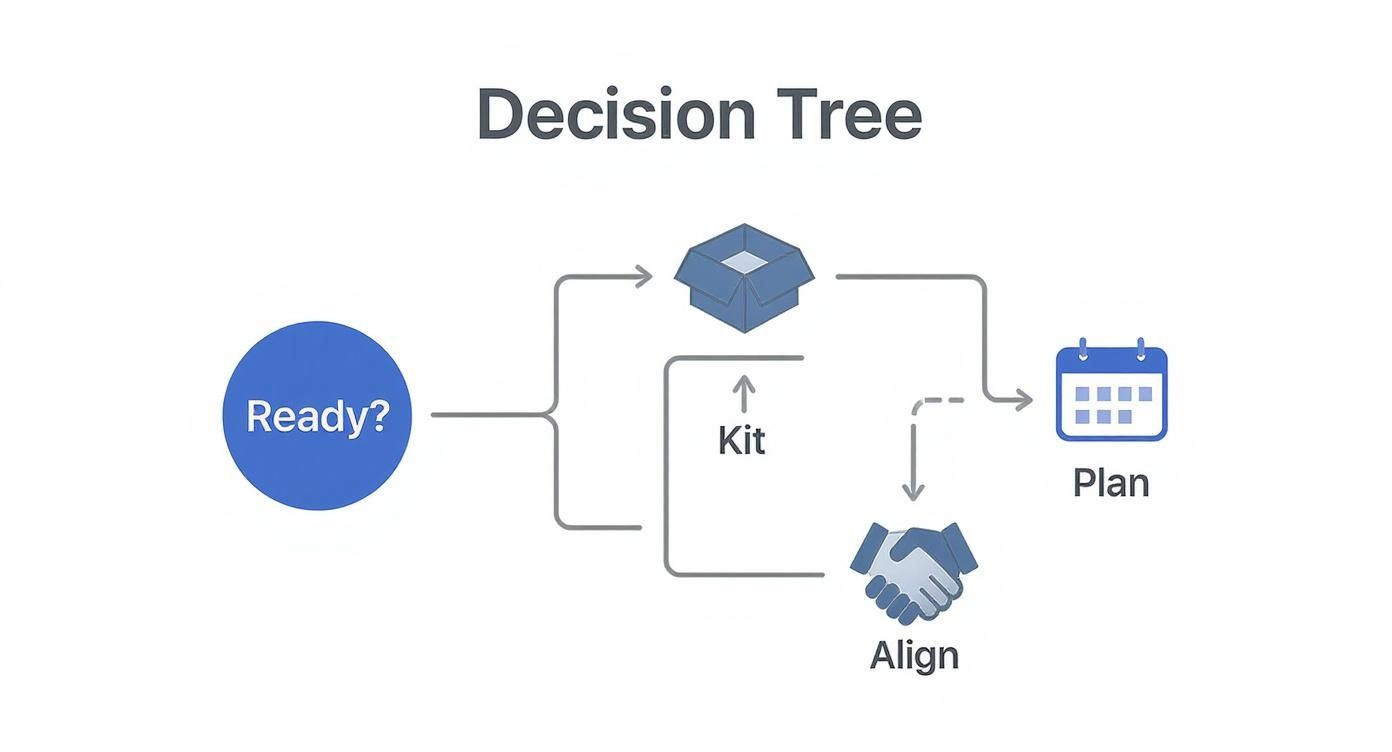
As you can see, being prepared is everything. Whether it’s through slick, automated resource delivery or direct human collaboration, a solid start sets the tone for the entire partnership.
Deciding what to automate versus what to personalize can be tricky. Here’s a quick breakdown to help you map out your process.
Onboarding Tasks Automation vs Personalization
| Task | Best Approach | Reasoning |
|---|---|---|
| Sending Welcome Email | Automation | Immediate, consistent first touchpoint. Can be triggered by a signed contract. |
| Kickoff Call | Personalization | The most critical relationship-building moment. Needs human empathy and strategy. |
| Sharing Standard Documents (MSA, etc.) | Automation | No customization needed. Efficiently gets necessary paperwork out of the way. |
| Creating a Project Workspace | Automation | Repetitive admin task. Tools can create boards or channels based on templates. |
| Personalized Welcome Video | Personalization | A high-impact, human touch that automation can't replicate. Builds instant rapport. |
| Scheduling Follow-up Meetings | Automation | Eliminates back-and-forth emails, saving time for both you and the client. |
| Customizing the Implementation Plan | Personalization | Requires understanding the client’s unique goals, challenges, and context. |
| Sending Status Update Reminders | Automation | Keeps the project on track with consistent, timely prompts without manual effort. |
This table shows a clear pattern: use automation for efficiency on repeatable tasks, but always reserve personalization for moments that build and deepen the client relationship.
Where a Human Touch is Non-Negotiable
While automation is a workhorse for efficiency, personalization is what builds the actual connection. These are the moments a machine can’t fake—the genuine interactions where your team’s expertise and empathy make a client feel truly understood.
Always keep these activities human-centric:
- The Kickoff Call: This is way more than a checklist review. It’s your prime opportunity to listen, ask smart questions, and build a real rapport.
- Custom Welcome Videos: A quick, authentic video from the account manager saying hello is incredibly powerful. It puts a friendly face to a name right from the start.
- Tailored Training: Ditch the generic demo. Use what you learned during the sales process to customize training that speaks directly to their pain points and goals.
This smart blend of automation and personal care doesn’t just make clients happier; it has a massive impact on your own team. From an internal perspective, companies with a strong onboarding process see an 82% increase in new hire retention and a productivity jump of over 70%. When your team feels supported and has clarity, they’re in a much better position to deliver that same amazing experience to your clients. A solid client onboarding process creates a ripple effect of success that strengthens your entire organization.
Defining Success and Setting Clear Expectations
I've seen it time and time again: misaligned expectations are the silent killer of client relationships. A partnership is doomed from the start if your definition of a “win” is completely different from your client’s. The kickoff meeting is your golden opportunity to get on the same page and build a roadmap for success together—before anyone starts the real work.
This meeting is more than just a project plan walkthrough. Think of it as a strategic alignment session. It's where you lock in concrete goals, map out realistic timelines, and agree on the exact metrics that will signal a successful outcome. When you do this as a team, you ensure everyone is running toward the same finish line.
The trick is to get specific. Vague goals like "increase sales" aren't helpful. Instead, aim for something tangible, like "achieve a 15% increase in qualified leads through the new landing page within 90 days." That kind of clarity eliminates guesswork and builds a solid foundation of trust.
Co-Creating a Success Plan
A success plan isn’t a document you hand over; it’s something you build with your client. During that kickoff meeting, your job is to facilitate a real conversation that gets to the heart of what matters to them. Ask probing questions to dig deeper than their initial requests and uncover the core business problem they’re actually trying to solve.
Use this discussion not just to define scope, but also to be upfront about potential roadblocks. What do you need from their team? What challenges could slow things down? Talking about these potential hurdles from day one shows you’re thinking ahead and helps manage expectations about the journey.
This approach changes the whole dynamic. You're not just a vendor; you're a true partner, and that's the key to keeping clients for the long haul.
By clearly outlining responsibilities for both your team and the client, you create mutual accountability. This simple act prevents future finger-pointing and makes sure everyone knows their part in hitting the shared goals.
Focusing on Time to Value
One of the most critical goals of any good onboarding process is to shrink your client's Time to Value (TTV). This metric is all about how quickly a new client gets a real, meaningful return from your service. A long, drawn-out onboarding process just breeds doubt and buyer's remorse.
So, structure your onboarding to deliver an early, tangible win. It doesn't have to be massive. This small victory builds crucial momentum and reassures them they made the right choice. It could be something as simple as successfully importing their first batch of data or launching a single, high-impact feature.
That initial positive experience is incredibly powerful for building long-term confidence and engagement. It proves your value right away and gets the relationship started on a high note.
Measuring What Matters
To know if you're on track, you have to agree on the right key performance indicators (KPIs). These metrics should be a direct reflection of the goals you set in the success plan. For a complete picture, it's smart to look at a mix of performance and satisfaction metrics. Our guide on how to measure work performance can help you establish the right internal frameworks for this.
Key indicators to watch include:
- Onboarding Completion Time
- Time to Value (TTV)
- Net Promoter Score (NPS)
- Early-stage support ticket volume
For example, the NPS—calculated as the percentage of promoters minus detractors from customer surveys—is a direct reflection of customer advocacy. And a great onboarding experience has a massive impact on that score. You can explore more about customer onboarding metrics on Onramp.us to see how these numbers tell the real story behind your process.
Creating a Feedback Loop for Constant Improvement

Your onboarding process should never be a "set it and forget it" system. The moment you stop refining it is the moment it starts becoming obsolete. The absolute best way to keep your onboarding sharp is to build a systematic feedback loop that turns client insights into your greatest asset for growth.
Listening isn't just about sending a survey when the project wraps up. Real improvement comes from gathering feedback at key moments throughout the entire initial journey. This approach gives you a much richer, more contextual understanding of where clients are thriving and where they’re hitting roadblocks.
Gathering Insights at the Right Moments
Instead of waiting until the very end, it’s far more effective to deploy lightweight feedback mechanisms at critical milestones. This proactive approach helps you spot issues before they morph into major frustrations.
Here are a few practical methods I’ve seen work wonders:
- Pulse Surveys After Key Steps: Once a client completes a big step, like the kickoff call or the initial setup, send them a quick one- or two-question survey. You could ask something simple like, "On a scale of 1-5, how clear were the instructions for setting up your account?"
- The 30-Day Check-In Call: This scheduled call is invaluable. It’s your chance to move beyond project updates and ask directly, "What has been the most confusing part of this process so far?" You get honest, unfiltered answers.
- Analyzing Support Tickets: Your support desk is an absolute goldmine of feedback. Are new clients constantly asking the same questions? A spike in tickets around a specific feature is a massive red flag that part of your onboarding is broken.
The goal is to make feedback a continuous conversation, not a final exam. By listening early and often, you can make small adjustments that prevent big problems and show clients that you genuinely care about their experience.
Turning Feedback into Actionable Change
Collecting data is only half the battle. Now, you actually have to do something with it. The final, most important step is to translate that raw feedback into tangible improvements. This requires a real commitment to analyzing trends and empowering your team to make changes based on what they learn.
I once worked with a marketing agency that noticed a troubling pattern during their 30-day check-in calls. A surprising number of clients mentioned they were confused about accessing their new performance dashboards. The agency assumed it was intuitive, but the feedback proved otherwise.
Their solution was simple but incredibly effective. They created a two-minute tutorial video walking new clients through the dashboard login and key features. They added this video to their welcome email and, within a month, saw a 40% drop in related support requests.
This case perfectly illustrates the power of a feedback loop. By actively listening and responding, they didn't just fix a problem—they made their onboarding process smoother, reduced their team’s support load, and massively improved the client experience from day one. To dig deeper into this, check out these client communication best practices and see how clear dialogue really fuels success.
Ultimately, listening is the ultimate growth hack.
Your Onboarding Questions Answered
Even with the best-laid plans, a few common questions always pop up when you're refining your client onboarding. Let's tackle some of the most frequent ones I've heard over the years, because getting these details right can make or break the entire experience.
How Long Should Client Onboarding Last?
This is the classic "how long is a piece of string?" question. There’s no single right answer, as it all comes down to the complexity of what you're offering. A simple software setup might be done and dusted in a few days. But for a sprawling enterprise solution, you could be looking at a 30 to 90-day journey.
The real goal isn't just to cross a finish line on a specific date. True success is when your client achieves that first meaningful win—that "aha!" moment where they feel confident and see the value for themselves. Instead of just watching the calendar, focus on hitting those critical milestones, like getting their setup finalized or seeing their first positive results.
What Are the Most Important Onboarding Metrics?
If you don't measure it, you can't improve it. To really understand how well your onboarding is working, you need to track a few key indicators that tell the whole story.
- Time to Value (TTV): This is the big one. How fast can you get your client from signing up to experiencing a real, tangible benefit? The shorter, the better.
- Product Adoption & Feature Usage: Are they just scratching the surface, or are they digging into the core features that truly deliver value? These rates show you how deeply they're engaging.
- Customer Satisfaction (CSAT): Don't guess how they feel—ask them. A quick satisfaction survey right after the main onboarding phase gives you immediate, honest feedback you can act on.
- Support Ticket Volume: Pay close attention to how many support tickets are coming from new clients. A spike in requests is a giant red flag that your instructions or the process itself isn't clear enough.
By keeping an eye on a mix of speed, engagement, and direct feedback, you get a 360-degree view of your onboarding's health. This lets you see exactly what’s working and what needs a tune-up.
How Do You Handle Unresponsive Clients?
We've all been there. A client goes dark, and the whole onboarding schedule grinds to a halt. The first step is to figure out why. Are they totally overwhelmed with information, or have other priorities simply pushed this project to the back burner?
Start with a polite follow-up email that clearly states what you need from them and—this is the crucial part—reminds them how it directly helps them achieve their goals. If emails are going into a black hole, don't hesitate to pick up the phone. A quick, personal call can often get things moving again.
Always frame the conversation around their success. Something like, "Just wanted to check in to make sure we stay on track to hit that Q3 goal we talked about." If the radio silence continues, you might need to loop in your main contact's manager, gently explaining that their team's input is essential for the project to succeed.
Ready to build a calmer, more efficient workflow for your legal team? With Whisperit, you can unify dictation, drafting, and collaboration to move from intake to export in fewer steps. See how Whisperit can transform your practice.