
A Guide to Modern Legal Search Solutions
Legal search solutions are a world away from the simple keyword searches you might be used to. Think of them less as a digital library and more as an AI-powered research assistant, designed to give lawyers contextual insights and data-backed analysis to build much stronger cases. They act like a specialized GPS for legal research, guiding you past outdated methods to a destination of accuracy and speed.
Why Modern Legal Research Demands a New Approach
Imagine trying to win a grand prix race using a paper map while your competitors have real-time GPS navigation. That’s the difference between traditional legal research and today's intelligent legal search solutions. The days of blowing dust off law books or running endless keyword queries in static databases are quickly becoming a memory. The modern legal field simply demands more—more speed, more precision, and deeper strategic insight.
This guide is all about the intelligent platforms that are reshaping how legal work gets done. We'll look at these solutions not as mere document dumps, but as dynamic, AI-driven tools that deliver actionable intelligence, not just a mountain of paperwork.
The Shift From Keywords to Context
The fundamental flaw in old-school research is its rigid reliance on exact keyword matching. You might search for "workplace injury liability" and completely miss a pivotal case that uses the phrase "on-the-job accident responsibility." The wording is different, but the core legal concept is the same. Modern tools get that.
A revealing study found that legal professionals spend, on average, 31% of their time just on case-related research. Intelligent search platforms are built specifically to slash that number, freeing up lawyers to focus on what truly matters: strategy.
By looking past simple text matching, these platforms uncover connections and precedents that would otherwise stay buried. It’s a fundamental shift that gives you a serious competitive edge.
What This Guide Will Cover
We're going to pull back the curtain on how these advanced systems work, what features you should actually care about, and the real-world impact they have on law firms and in-house legal teams. We'll explore:
- The Tech Behind It All: A look at how AI and Natural Language Processing (NLP) actually interpret legal language.
- Must-Have Platform Features: From predictive analytics to next-gen citation checkers, we’ll cover what to look for.
- Real Business Benefits: How these tools boost efficiency, minimize risk, and deliver a tangible return on investment.
- A Smart Selection Framework: Practical advice for picking the right solution that fits your practice's unique needs.
This is your starting point for understanding how to use these powerful legal search solutions to build more compelling arguments and gain a decisive advantage in your practice.
How AI Is Powering Legal Search Platforms

To really get what makes modern legal search solutions tick, you have to look under the hood. It all starts with digitizing a mountain of legal information—case law, statutes, regulations, you name it. But that digital library is just the starting point; the real magic comes from Artificial Intelligence (AI).
AI is the brain of the operation. It transforms a static database into a dynamic research partner that doesn't just fetch documents with matching words. Instead, it analyzes, interprets, and connects information in a way that feels a lot like human legal reasoning. That’s the game-changer.
The proof is in the numbers. The global legal AI market was valued at USD 1.45 billion in 2024 and is expected to hit USD 3.90 billion by 2030. This growth is fueled by machine learning and deep learning, which now make up over 63% of the legal tech space. It's clear AI isn't just a trend; it's becoming a fundamental part of legal practice.
Understanding Your Questions with NLP
So, how does it work? One of the core technologies is Natural Language Processing (NLP). Think of NLP as the system's ability to grasp language like a person would—understanding concepts, intent, and context, not just a jumble of words. When you type in a question, NLP gets to work figuring out what you really mean.
Let's say you ask, "What is the precedent for medical malpractice claims involving surgical errors in California?" An old-school system would get stuck looking for those exact keywords. An NLP-powered platform, however, instantly breaks down the core concepts:
- Legal Area: Medical Malpractice
- Specifics: Surgical Errors
- Jurisdiction: California
This means it can pull up relevant documents that talk about these ideas, even if they use completely different phrasing. It’s the difference between a simple word-finder and a research assistant who actually understands your request.
Finding Concepts, Not Just Keywords
This leads us to an even smarter capability: semantic search. Imagine searching for a "red ball." A keyword search will only find results that say "red ball." But a semantic search understands the concept and might also find documents mentioning a "scarlet sphere" or a "crimson orb."
This is a massive advantage in the legal world. You might be researching a case on "corporate malfeasance," and the system could surface a crucial precedent that uses the term "executive misconduct" instead.
Semantic search is all about uncovering information that’s conceptually similar. It ensures you don't miss vital case law just because it was phrased differently, bridging the gap between how lawyers think and how databases are built.
This ability to connect related ideas is what makes today’s legal search tools so incredibly effective. You can learn more about the differences between semantic search vs. keyword search in our detailed guide.
Predicting Outcomes with Data
The most sophisticated platforms take things a step further with predictive analytics. This technology sifts through historical case data, judicial rulings, and motion outcomes to spot patterns and forecast what might happen next. It's like having a statistical expert who has crunched the numbers on thousands of similar cases to give you an objective assessment.
Predictive tools can help you find answers to critical strategic questions:
- How has this specific judge ruled on similar motions before?
- What's the typical settlement for this kind of case in this jurisdiction?
- Which arguments have proven most persuasive in front of this court?
This kind of data-driven insight gives you a real strategic edge. It helps you build a smarter case strategy, manage your client's expectations, and negotiate from a much stronger position.
What Makes a Great Legal Search Solution?
Not all legal search platforms are cut from the same cloth. While most give you access to a mountain of case law, the truly great ones do more than just point you to the library. They come equipped with a specific set of smart features designed to help you think, analyze, and build your case more effectively.
Think of it like this: a basic word processor lets you type, but a modern collaborative writing tool gives you version history, real-time comments, and track changes. The best legal search tools offer that same level of support for the entire research workflow, moving far beyond a simple search bar.
Intelligent Search That Thinks Like a Lawyer
The heart of any modern platform is its search engine. But we're not talking about basic keyword matching anymore. The real power comes from a system that understands legal context, intent, and the complex web of citations that connect one case to another.
Here are the game-changing search tools to look for:
- Semantic Search: This is the magic that finds conceptually related documents, even if they don't use the exact keywords you typed. It ensures you don't miss a vital precedent just because a judge used different phrasing.
- Advanced Citation Analysis: It's more than just a list of cases citing a decision. The best tools instantly tell you if a case has been overturned, criticized, or distinguished, saving you from the career-ending mistake of relying on bad law. Some even map out the citation history visually.
- Natural Language Queries: Imagine just asking a question in plain English, like "What are the standards for summary judgment in federal court?" and getting a ranked list of relevant results. That’s what a good system can do, and it’s a massive time-saver.
This visual breakdown shows just how much more efficient these advanced capabilities are compared to slogging through research the old-fashioned way.
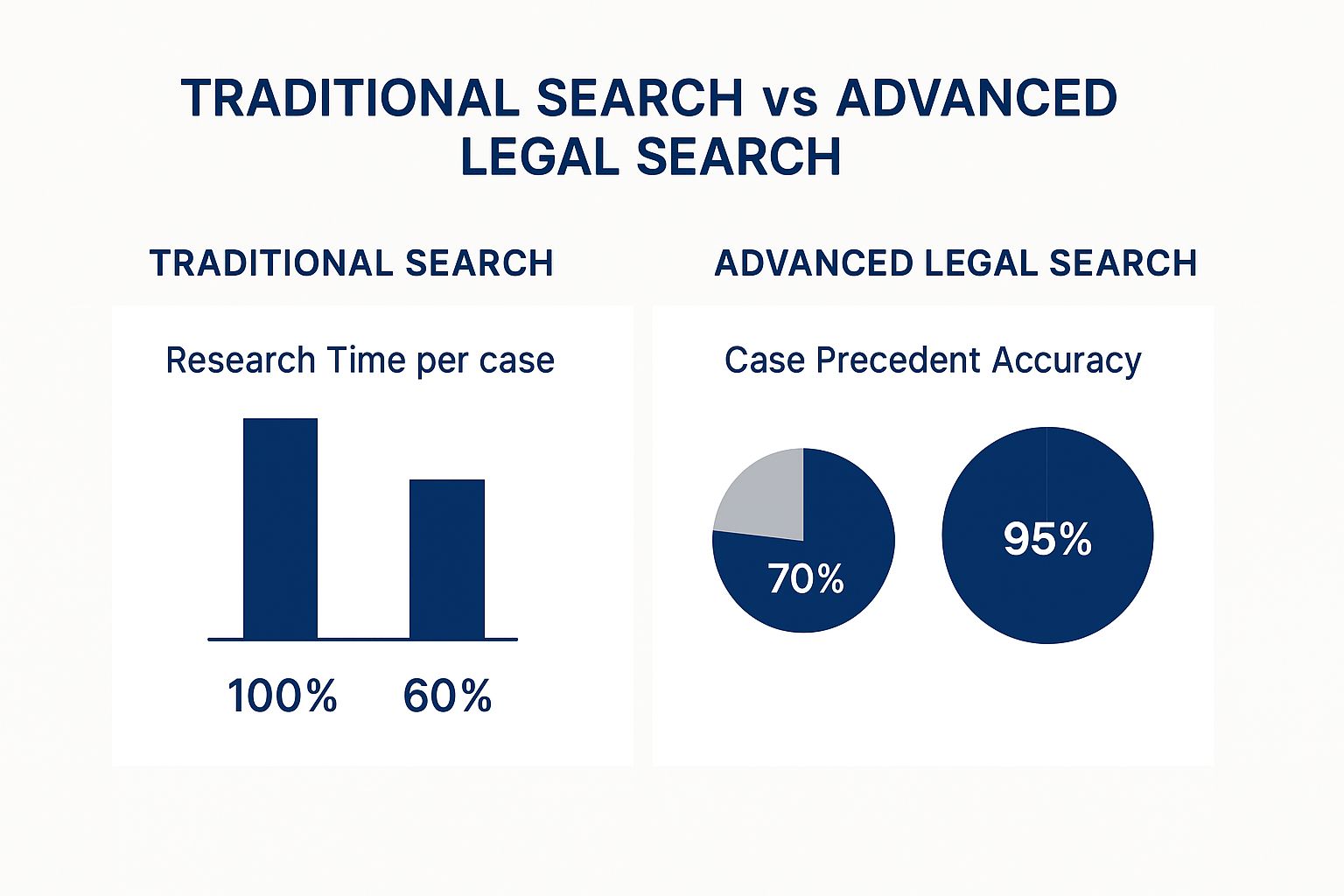
As you can see, the right tools don't just speed things up; they fundamentally improve the quality and accuracy of your work product.
To really understand the shift, let's compare the old way with the new.
Comparing Traditional vs Modern Legal Research
The move from manual research to AI-powered solutions represents a huge leap in efficiency and analytical power. This table breaks down the key differences.
| Research Task | Traditional Method (Manual) | Modern Solution (AI-Powered) |
|---|---|---|
| Finding Precedent | Keyword searches in print or basic databases. | Semantic search understands concepts, finding relevant cases with different phrasing. |
| Validating Case Law | Manually checking citation services (e.g., Shepardizing). | Automatic flags for negative treatment (overturned, criticized). |
| Organizing Results | Printing, highlighting, creating physical binders or scattered digital files. | Centralized digital workspaces with folders, tags, and annotations. |
| Summarizing Opinions | Reading and manually summarizing long, dense judicial opinions. | AI-generated summaries highlight key holdings and legal reasoning instantly. |
| Sharing with Team | Emailing links or sending physical copies of cases. | Collaborative dashboards allow real-time sharing of notes and findings. |
The takeaway is clear: modern solutions automate the tedious tasks, freeing you up to focus on strategy and analysis—the work that actually wins cases.
More Than a Search Bar: Case Management and Analytics
Top-tier platforms have moved beyond simply finding documents. They now include features that help you manage and analyze them, turning a research tool into a strategic command center.
For instance, a litigation team facing a massive eDiscovery request can use the platform to sift through terabytes of data. Instead of manually reviewing every file, the system can use predictive coding to automatically categorize documents as relevant or not. We're talking about saving hundreds of billable hours.
A great legal search solution doesn't just give you a pile of documents; it gives you the tools to make sense of that pile. It helps you find the needle in the haystack and then tells you what that needle means for your case.
This ability to manage information is non-negotiable. In fact, effective document management for law firms is the bedrock of any efficient modern practice. When you integrate search with management, you get a seamless, powerful workflow.
Organizing and Sharing Your Team’s Knowledge
Finally, the best platforms understand that legal work is a team sport. They include features that make it easy to organize your findings and share them with colleagues, building up a valuable, reusable knowledge base for the entire firm.
Here are the key collaborative features that make a difference:
- Shared Workspaces: You can create dedicated folders for each case. Here, team members can save key documents, add their own annotations, and share notes—all in one place.
- Automated Summaries: Some tools use AI to whip up concise summaries of lengthy judicial opinions. This helps you get the gist of a case's holdings and reasoning in seconds.
- Knowledge Management Integration: This is a big one. It's the ability to tag and save important research to a firm-wide knowledge bank, so teams stop reinventing the wheel. A junior associate can quickly search past work product to see how a similar issue was handled before.
This transforms individual research efforts into a lasting collective asset. Every hour spent on research builds value for the entire firm, boosting consistency and efficiency on all future matters.
The Real-World Benefits for Your Legal Practice

It's one thing to talk about advanced features, but what really matters is how a legal search solution impacts your day-to-day work. The true test isn't the technology itself, but the tangible results it delivers for your firm—stronger case outcomes, happier clients, and a healthier bottom line. These tools do far more than just find documents; they give you a genuine competitive edge.
This shift isn't just a trend; it's a major industry investment. The market for legal research software was valued at around USD 9.2 billion in 2024 and is expected to more than double to USD 18.7 billion by 2033. This surge shows just how much the legal world is counting on these tools to bring real efficiency and accuracy.
Let’s get into the specific benefits you can actually expect.
Drastic Efficiency Gains
The first thing you'll notice is the time you get back. Think about the hours spent on tedious, manual research. These solutions automate that grunt work, freeing up your team to focus on what truly matters: building case strategy, advising clients, and preparing for court.
This isn't just about moving faster. It's about reallocating your most precious asset—your team's expertise. When associates aren't spending days chasing down obscure precedents or triple-checking citations, they're developing the skills that win cases. This is a core principle behind modern https://www.whisperit.ai/blog/legal-workflow-automation, which is all about optimizing how your firm operates.
Reduced Risk and Improved Accuracy
In the legal field, one missed precedent can unravel an entire case. Manual research, for all its diligence, is still subject to human error. It’s surprisingly easy to overlook a key ruling or misread a citation’s history. An AI-powered legal search tool acts as your ultimate safety net.
These platforms slash your risk in a few key ways:
- Automated Citation Checks: They instantly flag cases that have been overturned or weakened, so you never build an argument on shaky ground.
- Comprehensive Search: Semantic search goes beyond keywords to find conceptually related documents, ensuring you see the whole picture.
- Consistent Application: The system applies the same rigorous search logic every single time, removing the variability that comes with different people using different research methods.
By making sure your research is both exhaustive and accurate, you protect your clients, your firm’s reputation, and your own peace of mind.
Enhanced Strategic Insights
Modern legal search platforms are more than just libraries; they're powerful analytical tools. They can sift through immense volumes of data to reveal patterns and trends that a human researcher could never spot, handing you a serious strategic advantage.
Imagine a small firm going up against a corporate giant. By using their platform’s analytics, they analyzed the presiding judge’s rulings on similar motions. They found the judge had a clear pattern of favoring arguments based on a specific, less-common statutory interpretation. The firm built their entire strategy around this insight and won a summary judgment—a move their opponent never anticipated.
This is where the real power lies. Moving beyond just research tools, firms that also embrace modern digital approaches like effective SEO strategies for legal practices can truly pull ahead of the competition. When you let data guide your strategy, you can craft more compelling arguments, predict your opponent’s next move, and negotiate from a position of strength.
How to Choose the Right Legal Search Solution
Picking the right legal search tool is one of those foundational decisions that can seriously impact your firm's efficiency for years to come. It’s easy to get wowed by a slick sales demo, but what you really need is a clear-eyed approach to find a platform that actually fits how you work—whether you’re neck-deep in high-stakes litigation, meticulous transactional work, or complex compliance issues.
The whole process has to start with an honest look in the mirror. Where are the real pain points in your current research process? Are junior associates burning too many hours on basic case-finding? Are you constantly worried about missing that one critical, on-point case that torpedoes your argument? Nailing down these needs first is the only way to make a smart investment you won't regret later.
Define Your Practice’s Unique Requirements
Before you even agree to a demo, you need to map out what your firm actually needs. There’s no such thing as a one-size-fits-all solution here. The perfect tool for a small criminal defense firm is going to look completely different from what a large M&A team at a corporate firm requires.
Start by asking some tough questions to build a scorecard for your ideal tool. This internal audit becomes your north star when you start evaluating vendors.
Think about these key areas:
- Practice Area Specialization: Does the platform offer deep, authoritative content in your specific field, like tax, IP, or family law? A generic database just won't cut it for specialized work.
- Firm Size and Scalability: Will the pricing and features grow with you? You want flexible subscription models that don’t punish you for success by making it a headache to add new users.
- Primary Use Cases: What will you be doing 80% of the time? Is it case law research for motions, due diligence for corporate deals, or keeping up with constantly shifting regulations? Pinpoint your most frequent tasks.
Getting this right from the start ensures you’re shopping for a solution to your actual problems, not just buying the one with the flashiest features.
Evaluate Core Platform Capabilities
With your requirements list in hand, it’s time to get under the hood of the platforms themselves. It really boils down to three things that determine a tool's real-world value: the quality of the content, how easy it is to use, and whether it plays nicely with the other software you already rely on.
First, you have to kick the tires on the database. The depth and freshness of a platform's legal library are absolutely non-negotiable. Make sure it has comprehensive primary sources (cases, statutes) and essential secondary sources (treatises, law reviews) for all the jurisdictions you practice in. And don't be shy—ask vendors how often they update everything. In law, information that's even a week old can be a liability.
Next up is the user experience. A powerful tool is worthless if your team finds it clunky or confusing. A clean, intuitive design isn't just a "nice to have"; it shortens the learning curve and means your lawyers will actually use it.
A study on legal tech adoption found that user experience is a primary driver. If a platform isn't easy to use, attorneys will simply revert to their old, less efficient methods, wasting the firm's investment.
Finally, think about integration. Your legal search solution can't be an island. It needs to connect smoothly with your other critical tools, especially your case management software. This allows you to shuttle research, documents, and notes back and forth without wasting time on mind-numbing manual data entry. For smaller firms just starting to build their tech stack, understanding how all the pieces fit together is crucial. Our guide on the best legal software for small firms can provide some valuable context here.
Analyze Pricing Models and Total Cost of Ownership
Legal tech pricing can be a minefield of complex plans, hidden fees, and confusing add-ons. You have to look past the sticker price and calculate the Total Cost of Ownership (TCO). Always get clarity on what’s included in a standard subscription versus what costs extra.
Here’s a quick look at the common pricing structures you’ll run into:
- Flat-Rate Subscriptions: A predictable monthly or annual fee for unlimited access. This is great for budgeting and a favorite for firms that do a lot of research.
- Pay-As-You-Go: You're charged based on what you use—per search, per document, or even per minute. This can be a smart move for firms that only need to do research occasionally.
- Tiered Plans: Different subscription levels that unlock more features or content. The trick is to find the tier that matches your needs without overpaying for bells and whistles you’ll never use.
Always ask for a detailed price breakdown. What are the costs for training, customer support, and getting your data moved over? A vendor who is transparent about every potential expense is one you can trust to help you make a sound financial decision for your practice.
What's Next for AI in Legal Research and Analytics?
The evolution of legal search tools is nowhere near finished. We're moving into an era where these platforms won't just find information for you—they'll help you create legal work, predict case outcomes with startling accuracy, and weave together scattered data points into a single, strategic picture. The momentum is undeniable.
You can see this shift reflected in the market numbers. The global legal analytics market is expected to explode from USD 5.57 billion in 2024 to a massive USD 61.9 billion by 2035. That’s a compound annual growth rate of about 24.47%. For a closer look at these projections, check out the analysis from Market Research Future.
The Leap into Generative AI
The biggest game-changer on the horizon is Generative AI. Picture a system that doesn't just pull up relevant case law but actually drafts a preliminary summary of key arguments for you. Or maybe it spits out an initial motion based on the precedents it found. This technology is set to handle the first pass, freeing up attorneys to do what they do best: strategize, refine, and perfect the final work.
This move from pure research retrieval to research-driven creation will turn hours of initial drafting into mere minutes. To learn more about how this works in practice, take a look at our complete guide to legal research AI for your law practice.
Tying It All Together with Interconnected Data
Future legal search platforms will also start tearing down the walls between different data sources. Instead of running separate searches for case law, then regulatory filings, then corporate records, the next wave of tools will give you a unified view. They'll paint a 360-degree picture of a legal matter by pulling information from all these places at once.
Think about what this means for analyzing a corporate merger. A single query could deliver:
- Relevant case law on potential antitrust issues.
- The latest regulatory guidance from the SEC.
- Financial filings and board minutes from both companies.
The real power of future legal tech isn't about replacing lawyers; it's about amplifying their strategic thinking. These tools will become partners, managing the data firehose so legal professionals can focus on judgment, ethics, and advocacy.
This interconnected approach gives you a much richer context, helping you spot risks and opportunities that you might have otherwise missed. Of course, the ethical responsibility for the final work product still rests squarely on the attorney's shoulders. Human oversight and professional judgment will become more crucial than ever, ensuring these powerful AI tools are used responsibly to serve the client's best interests.
A Few Common Questions
It’s only natural to have questions before bringing a new piece of technology into your practice. Any significant change comes with a learning curve and practical concerns. Let's walk through some of the most common questions legal professionals ask when considering a modern search tool.
Are These Platforms Only for Big Law?
That’s a common misconception, but it’s really a holdover from the old days when this kind of tech was incredibly expensive. The world has changed. Thanks to cloud computing and Software-as-a-Service (SaaS) models, powerful legal search is no longer just for the big players.
Most vendors now offer flexible pricing, with tiers designed specifically for small firms and even solo practitioners. You pay for what you need, which means you can get the same research horsepower as a massive firm without the enterprise-level price tag. It’s a great equalizer.
How Secure Is Our Client Data?
For any lawyer, data security is paramount. It’s not just a feature; it’s a foundational requirement. The best legal search solution providers understand this and build their platforms with security at their very core.
They use a multi-pronged approach to keep your confidential information locked down.
- End-to-End Encryption: Your data is scrambled both in transit and at rest, making it useless to anyone without authorized access.
- Strict Access Controls: You decide exactly who on your team can see or touch specific documents, giving you complete control.
- Compliance with Standards: Reputable platforms meet tough security standards like SOC 2 and follow data privacy laws like GDPR.
Bottom line: your firm’s and your clients’ data is protected by the same kind of security the big banks use.
Will AI Make Our Junior Associates Obsolete?
This is the big one, and it comes from a place of real concern. But it’s based on a fundamental misunderstanding of the technology’s purpose. AI-driven search is designed to amplify a lawyer's expertise, not replace it. Think of it as an incredibly capable assistant, not a replacement.
These platforms are force multipliers. They take on the grueling, low-value work—like digging through a mountain of documents for a single fact—so your team doesn't have to.
This frees up your junior associates to stop being document sifters and start being lawyers. They can dedicate their time to the work that actually builds their careers: crafting arguments, thinking strategically, and developing real legal analysis skills. The tech finds the needle in the haystack, so your team can figure out what to do with it.
Ready to transform your document workflow with secure, AI-powered efficiency? Whisperit helps legal professionals complete paperwork up to two times faster. Discover how our Swiss-hosted, privacy-first platform can give you a competitive edge.