
Embrace Technology in Law Firms for Legal Success
Adopting new technology in law firms isn't just a trend anymore—it's become a fundamental part of staying competitive and keeping clients happy. We've moved far beyond basic office software. Today's most successful firms are weaving sophisticated systems into their daily operations to automate routine work, lock down sensitive data, and ultimately provide faster, more accurate legal services. It's a shift that's changing the very DNA of legal practice.
The Shift to the Modern Digital Law Firm

The legal world, long associated with stacks of paper and manual, time-consuming tasks, is in the middle of a massive overhaul. Becoming a modern digital law firm is about so much more than getting new computers; it’s a complete re-think of how work gets done to meet today's demands for speed and security. Clients have changed, too. They now expect instant updates and total transparency, something old-school methods just can't deliver.
This evolution is powered by a handful of key technologies that have become the new foundation for a modern practice. Each one plays a critical role in building a firm that's not just more efficient, but also more resilient.
Core Drivers of Legal Transformation
The push for this digital-first approach is coming from all sides. Internally, firms are realizing that clinging to manual processes is a recipe for inefficiency and costly errors. These old ways create bottlenecks and introduce risks that are no longer acceptable. At the same time, clients who are used to seamless digital experiences in every other part of their lives now demand the same level of service from their lawyers.
A few key technologies are making this all possible:
- Cloud Computing: By moving data and software off of local servers and into the cloud, firms gain secure, scalable access to everything they need, from anywhere. This has been a game-changer for enabling remote work and creating solid disaster recovery plans.
- Artificial Intelligence (AI): AI is no longer science fiction. It's here, automating tedious jobs like document review and legal research. This frees up lawyers to focus on what they do best: strategy and high-level client work. In fact, a recent report found that 80% of legal professionals see AI having a significant or transformative impact on their jobs within the next five years.
- Advanced Cybersecurity: As firms go digital, they become a much bigger target for cybercriminals. Protecting sensitive client data isn't just good practice; it's an ethical obligation. Modern security measures like end-to-end encryption and multi-factor authentication are now non-negotiable.
This is all part of a much bigger picture. To get a more detailed look at this industry-wide movement, you can explore our complete guide on the digital transformation in the legal industry.
Embracing a Firm-Wide Digital Mindset
Making technology work in a law firm requires more than just a healthy IT budget. It calls for a genuine cultural change where everyone, from partners to paralegals, is on board. As firms make this transition, it’s helpful to look at how other departments handle similar shifts. For instance, many of the ideas from digital transformation in human resources can provide a great roadmap for staff training and adapting job roles.
The real goal is to create a practice where technology is seamlessly woven into the firm's core strategy. It should be an enabler, helping lawyers deliver outstanding service, safeguard client data, and operate at their absolute best. This foundation doesn't just solve today's problems—it prepares the firm for whatever comes next.
Building Your Firm's Legal Tech Stack
Thinking about your firm’s software as a bunch of separate programs is like looking at a car as a pile of parts. To actually get anywhere, those parts need to work together as a single, well-oiled machine. That integrated system of tools is your firm’s legal tech stack, and building it with intention is how you unlock some serious advantages.
A well-designed tech stack does more than just add features; it creates a natural flow of information from one tool to the next. This synergy gets rid of tedious data entry, cuts down on human error, and gives your whole team a single, clear picture of every case and client. It's the digital backbone of any modern, efficient law firm.
The Central Command Center: Practice Management Software
At the very core of any solid legal tech stack is the Practice Management Software (PMS). You can think of it as the firm's central nervous system or even an air traffic control tower. It coordinates all the mission-critical functions that keep your practice moving forward, from client intake and conflict checks to time tracking and billing.
A good PMS gives you a single source of truth for all case information. Instead of digging through disconnected spreadsheets, endless email chains, and stacks of paper files, your team can pull everything up on one unified dashboard. This makes sure everyone is on the same page, which is absolutely vital for collaboration and making smart decisions on the fly.
A modern Practice Management Software solution is more than just a calendar and a billing tool. It's a strategic asset that provides the data and oversight needed to manage workloads, track profitability, and deliver a consistently high level of client service.
The benefits of a solid PMS become obvious pretty quickly, as the image below highlights.
This visual breaks down how legal technology directly boosts efficiency, lowers costs, and strengthens risk management protocols within a firm.
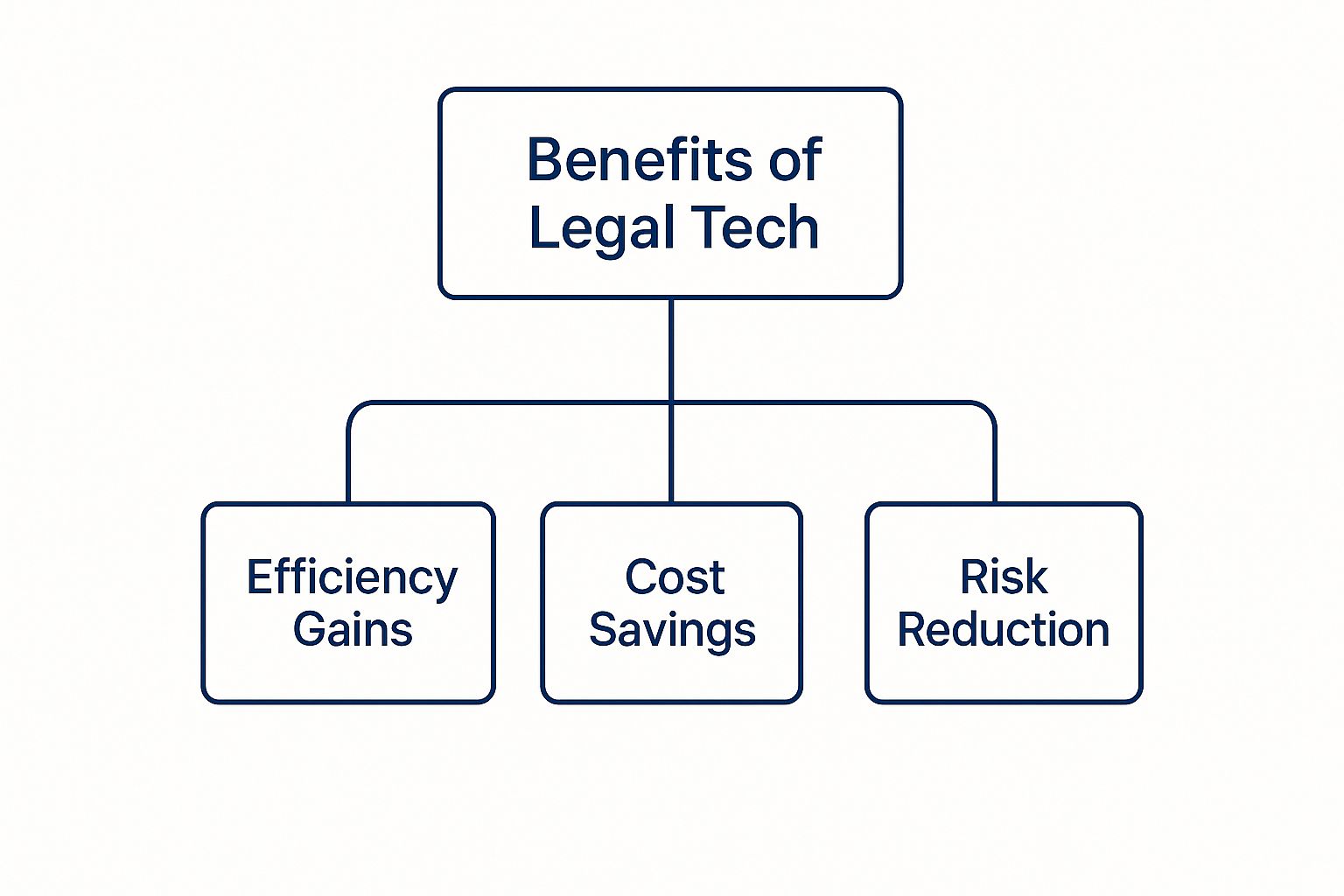
As the diagram shows, investing in the right tools creates a powerful feedback loop where each benefit builds on the others.
To better understand how these tools fit together, let's look at the core components of a modern legal tech stack.
Core Components of a Modern Legal Tech Stack
| Technology Category | Primary Function | Key Benefits |
|---|---|---|
| Practice Management | Centralizes case, client, calendar, and billing data into one system. | Improves workflow efficiency, provides firm-wide oversight, and ensures data consistency. |
| Document Management | Securely stores, organizes, and tracks all firm documents and files. | Enhances security, enables version control, and makes information instantly searchable. |
| E-Discovery | Processes and analyzes large volumes of electronic data for litigation. | Speeds up review, reduces discovery costs, and improves accuracy in identifying key evidence. |
| Client Communication | Provides secure portals and tools for client interaction and updates. | Boosts client satisfaction, secures sensitive communications, and creates a clear audit trail. |
| Legal Research | Offers access to case law, statutes, and legal databases. | Accelerates research, ensures up-to-date legal knowledge, and strengthens legal arguments. |
Each of these categories plays a distinct but interconnected role, forming the foundation for a more productive and secure practice.
The Secure Digital Archive: Document Management Systems
If the PMS is your command center, then the Document Management System (DMS) is the firm's secure, intelligent digital archive. Law firms generate an incredible amount of paperwork—contracts, motions, emails, evidence. A DMS brings order to that chaos, making everything secure, searchable, and easy to access.
Unlike basic cloud storage like Dropbox or Google Drive, a DMS built for the legal industry comes with critical features:
- Version Control: This is a lifesaver. It ensures everyone is working from the latest draft, preventing costly mistakes that come from using an outdated document.
- Granular Permissions: You can control exactly who sees, edits, or shares specific files, which is essential for protecting confidential client information.
- Advanced Search: Forget simple keyword searches. These tools let you find specific documents or even clauses within documents in seconds—a task that could otherwise take hours.
For small firms just starting to build their stack, picking the right foundational tools is key. We've put together a guide to help you compare your options: best legal software for small firms.
The High-Powered Lens for Litigation: E-Discovery Tools
For any firm that handles litigation, e-discovery platforms are no longer a luxury—they're a necessity. Discovery has shifted from boxes of paper to petabytes of electronic data, and finding that "smoking gun" has become infinitely more complex. E-discovery tools are the high-powered lenses that help legal teams sift through massive amounts of electronically stored information (ESI) efficiently.
These platforms use sophisticated algorithms and AI to quickly identify relevant documents, flag privileged information, and manage the entire review and production process. This doesn't just speed up the discovery timeline; it also massively cuts down on the cost and headache of dealing with huge datasets. Of course, a complete tech stack doesn't stop with legal-specific software. Many firms also use digital marketing tools like SEO plugins to build a stronger online presence and attract new clients.
How AI Is Really Changing the Day-to-Day at Law Firms
Let's get one thing straight: AI isn't about replacing lawyers with emotionless robots. It's about giving every attorney a brilliant, tireless assistant who can handle the grunt work.
Think of it as a force multiplier for legal expertise. AI takes on the repetitive, data-heavy tasks that eat up so many billable hours. This frees up lawyers to focus on what they do best: building strategy, advising clients, and navigating complex legal arguments. That’s where their true value lies.
This isn't some far-off future, either. The shift is happening right now. Between 2023 and 2024, the adoption of AI in law firms nearly tripled, jumping from 11% to a staggering 30%. In larger firms, the number is even higher—46% are already using AI. This rapid growth shows that integrating this powerful technology in law firms is no longer a choice but a competitive necessity. You can dig into the complete findings in the American Bar Association's 2024 report on LawNext.com.
This surge is being driven by some very real, tangible results.
The Two Flavors of Legal AI
Not all AI is built the same. In a law firm, you'll generally run into two main types, each serving a completely different—but equally important—purpose. Knowing the difference is crucial for building a smart tech stack.
- Analytical AI: This is your digital detective. It's built to sift through mountains of data to spot patterns, flag anomalies, and pull out relevant facts. Imagine a super-powered paralegal who can tear through thousands of documents for e-discovery in minutes or pinpoint a specific clause across a huge portfolio of contracts.
- Generative AI: This is your creative partner. It uses what it has learned from vast datasets to generate new content. We're talking about drafting the first version of a legal brief, summarizing a lengthy deposition, or even whipping up a client update. It gives attorneys a solid foundation to build on, not a blank page.
More often than not, these two types of AI work hand-in-hand to make complex legal workflows much smoother from beginning to end.
Taming the Document Beast
One of the most immediate and powerful applications of AI is in contract analysis and due diligence. During a merger or acquisition, legal teams might have to review tens of thousands of contracts. Done manually, this work is mind-numbingly slow, incredibly expensive, and ripe for human error.
Analytical AI tools can chew through this entire process automatically. You can train them to:
- Pinpoint Specific Clauses: Instantly find every contract with a non-compete agreement or a particular liability term.
- Flag Risky Language: Highlight any wording that deviates from your firm’s approved templates, putting a spotlight on potential risks.
- Pull Out Key Data: Extract critical information like renewal dates, payment terms, and involved parties into a neat, structured spreadsheet.
AI turns document review from a search for a needle in a haystack into a process where the AI hands you every single needle, all neatly organized. This lets lawyers jump straight to the high-value work of assessing risk and giving strategic advice.
Platforms like IBM's Watson are making these powerful tools more accessible, allowing firms to build and manage AI models tailored to their specific needs.
This kind of interface shows how complex AI systems are becoming easier to manage, letting firms customize solutions for their unique legal challenges.
Sharpening Legal Research and Strategy
AI is doing more than just sorting documents; it's fundamentally changing how legal research gets done. The old way involved hours of plugging keywords into legal databases and hoping for the best.
AI-powered platforms, on the other hand, understand natural language and context. An attorney can simply ask, "Show me federal court rulings in the last five years where a software patent was invalidated due to prior art." The AI analyzes case law, grasps the legal concepts, and returns a highly relevant list of cases, often with concise summaries. It's not just faster—it can uncover precedents a manual search might have missed. To see how these tools are being put to work, check out our deep dive on the intersection of law and AI.
And the impact of AI doesn't stop with legal work. It's also streamlining the business side of the firm. For example, a modern digital law firm might use a definitive guide on AI for talent acquisition to find and hire the best people, proving just how versatile this technology has become.
Protecting Client Data in the Digital Age

As law firms lean more heavily on digital tools to store sensitive information, they've inadvertently painted a target on their backs. The very technology in law firms that creates efficiency also opens up new avenues for cybercriminals.
Protecting client data is no longer a job for the IT department alone. It’s now a core ethical and professional duty for every single person at the firm. This responsibility goes far beyond just having antivirus software. It demands a proactive, firm-wide security culture where safeguarding confidential information is second nature. The fallout from a data breach—crippling financial penalties, a shattered reputation, and a total loss of client trust—is simply too great to risk.
Understanding the Modern Threat Landscape
The threats law firms face today are clever and insidious. They're designed to exploit human error, not just technological gaps. Cybercriminals are keenly aware that legal professionals are gatekeepers to a treasure trove of sensitive data, from corporate trade secrets to intensely personal information.
They typically rely on a few proven tactics:
- Phishing Scams: These are emails cleverly disguised to look like they're from a trusted source—a client, a court, or even a software vendor. The goal is to bait an employee into clicking a dangerous link or giving up their login credentials.
- Ransomware: Imagine one day you can't open a single file on your network. That's ransomware. This malicious software encrypts everything and holds it hostage until a massive payment is made.
- Social Engineering: This is the broader art of manipulation. It could be a convincing phone call from someone pretending to be an IT technician or an urgent-sounding message designed to make you act before you think.
These attacks are growing more sophisticated by the day, which makes ongoing vigilance and training non-negotiable. To really dig into building a solid defense, take a look at our complete law firm data security guide to protecting client info.
Building a Strong Digital Defense
Protecting your firm requires a defense-in-depth approach that layers technology, clear policies, and continuous education. Think of it like securing a castle: you need strong walls (technology), alert guards (your team), and clear rules for everyone inside (policies). A single weak point can bring the whole thing down.
The foundation of this defense is built on fundamental security controls. These aren't fancy add-ons; they are essential components for any modern, secure practice.
Key defensive strategies include:
- Multi-Factor Authentication (MFA): This is one of the single most effective security measures you can implement. MFA requires a second proof of identity—like a code sent to your phone—in addition to your password. It makes stolen passwords virtually useless to a hacker.
- End-to-End Encryption: Encryption essentially scrambles your data into an unreadable code that can only be unlocked with a specific key. By encrypting all data, whether it's sitting on a server ("at rest") or being sent in an email ("in transit"), you ensure that even if it's stolen, it's completely useless to the thief.
- Regular Security Audits: You can't fix a weakness you don't know you have. A security audit brings in an outside expert to test your defenses, find the vulnerabilities, and give you a clear plan to fix them before a criminal can exploit them.
These technical measures are your first line of defense, but they're only as strong as the people using them.
Creating a Proactive Security Culture
Technology can only take you so far. A law firm's greatest security asset is a well-trained, vigilant team. The ultimate defense is fostering a culture where every employee feels a personal responsibility for protecting data.
This starts with training that’s more than just a boring annual presentation. Staff needs regular, engaging education on how to spot phishing attempts, why password hygiene matters, and the proper way to handle sensitive client files.
Cybersecurity has emerged as a top IT priority, climbing from 31% to 37% in 2025 as firms intensify efforts to educate staff on threats. However, a significant gap remains, as 66% of firms allocate IT spending primarily to boost productivity, while only 12% prioritize cybersecurity enhancements in their budget. Read the full research on legal IT priorities on Tabush.com.
This statistic reveals a worrying disconnect. While firms know the threat is real, the investment doesn't always follow, leaving them exposed. A proactive security culture bridges that gap by making data protection a shared value, ensuring it’s a top consideration in every action the firm takes.
Creating a Practical Tech Implementation Roadmap
Bringing new technology into a law firm isn't just a matter of buying and installing software. It's a full-blown change management project. Without a solid plan, even the most promising tech can end up as expensive shelfware, leaving you with nothing but a wasted budget and a frustrated team. A well-thought-out implementation roadmap is your GPS, guiding you from a good idea to successful, firm-wide adoption.
This journey starts long before you ever see a sales demo. The first step is to take an honest look at how your firm actually works. Where are the real bottlenecks? What are the biggest headaches? Maybe your attorneys are burning hours on manual document review, or perhaps your billing process is slow and riddled with errors. Answering these questions gives you clear, concrete goals for what you need the technology to achieve.
Starting with a Solid Business Case
Once you've zeroed in on the problems, you can build a business case. This isn't just about getting the partners to sign a check. It’s about showing everyone—from the managing partner to the newest paralegal—how this new tool will make their job better, faster, or easier.
Your business case needs to spell out the return on investment (ROI), which isn't always about dollars and cents. Think about it in these terms:
- Time Savings: How many billable hours will be clawed back from tasks like legal research or contract drafting?
- Error Reduction: What’s the potential cost—in both money and reputation—of a mistake the new tech could prevent?
- Better Client Service: How will quicker responses or clearer communication make clients happier and more likely to stick around?
Getting this foundation right is everything. For a more detailed look at how to structure this process, our guide on a digital transformation roadmap and strategy provides some excellent frameworks you can adapt for your firm.
Phasing Your Rollout for Success
Whatever you do, don't attempt a "big bang" launch where everyone gets the new software at once. That's usually a recipe for chaos. A phased rollout is a much smarter, safer bet. It lets you iron out the wrinkles, listen to feedback, and build some positive buzz with a small group before going firm-wide.
Start with a pilot program. Pick a team that's generally open to new tech or a specific practice group that stands to benefit the most. This gives you a low-risk sandbox to see how the software performs in the real world. The success stories and praise from this pilot group will become your best marketing tool for winning over more skeptical colleagues.
An implementation plan that ignores the human element is destined to fail. Technology doesn't run a law firm—people do. The roadmap must prioritize clear communication, effective training, and demonstrating tangible value to every user.
This people-first mindset is critical, especially when you're introducing something complex like AI. People adopt technology at different speeds. A 2025 report that surveyed 2,800 legal professionals found that while 31% had personally used generative AI for work, adoption varied wildly. Civil litigation firms were out front at 27% adoption, while other practice areas were much further behind. As you can learn from these AI adoption trends in the legal field on mycase.com, you have to tailor your rollout to the people and their specific needs.
Focusing on Training and Support
Great training is the bridge between having technology and using it effectively. A one-size-fits-all, conference-room-style training session just doesn't cut it. The training needs to be tailored to different roles. Attorneys need to see how a tool will sharpen their legal work, while support staff might need to focus on how it improves workflow and organization.
A solid training plan should include:
- Initial Onboarding: Get everyone up to speed on the software's core features and, most importantly, why the firm invested in it.
- Role-Specific Workshops: Offer hands-on sessions showing people exactly how to use the tool for their day-to-day tasks.
- Ongoing Resources: Don't let the learning stop. Build a library of short video tutorials, quick-reference guides, and FAQs that people can access whenever they need them.
- Designated Champions: Find those enthusiastic early adopters in each department and empower them. They can become the go-to person for their peers, offering informal help and encouragement.
When you invest in continuous training and support, you turn a potentially intimidating piece of technology into an indispensable tool. This deliberate, methodical approach is what ensures your investment truly pays off, giving your firm a real competitive edge.
The Future of Legal Technology and What to Expect

The pace of change for technology in law firms isn't hitting the brakes anytime soon. If you think the last few years were big, just wait. We're now watching the next wave of innovation move beyond simple task automation and into the core strategic heart of legal practice—helping firms predict what's next and advise clients with unprecedented insight.
These aren't just far-off ideas from a sci-fi movie; they're trends with real, practical momentum building behind them. Getting a handle on these shifts is crucial for any firm that wants to lead the pack, not just keep up.
The Rise of Unified Legal Platforms
For too long, the typical law firm's tech stack has been a jumble of separate tools. You have one piece of software for billing, another for document management, and maybe a handful of others for client communication. It’s clunky and disconnected.
The future is all about bringing these functions under one roof. We’re finally seeing a serious push toward integrated, all-in-one platforms. Think of it as swapping a messy toolbox full of mismatched tools for a single, powerful multi-tool that does everything you need.
These unified systems let information flow freely, breaking down the data silos that cause so many headaches. Suddenly, everyone is working from a single source of truth for every case, which does wonders for collaboration. For firm leadership, it offers a crystal-clear, live dashboard of everything from operations to profitability.
Predictive Analytics and Data-Driven Strategy
Right now, AI is fantastic at chewing through past information to find patterns. The next big step? Using that power to predict what's going to happen. Predictive analytics is quickly becoming an essential tool for litigation, helping lawyers size up a case by sifting through millions of data points from past court decisions.
Imagine being able to forecast potential damage awards, calculate the odds of a motion being granted, or even model a specific judge's leanings based on their entire case history. That’s what’s coming.
Predictive analytics gives lawyers a data-backed compass for navigating litigation. It transforms strategic decisions from being based on experience and intuition alone to being supported by robust statistical evidence, offering clients a clearer picture of their risks and options.
Blockchain and Smart Contracts
You've probably heard about blockchain as the engine behind cryptocurrencies, but its potential in transactional law is massive. At its core, blockchain creates an unchangeable, hyper-secure record of information. It’s the perfect fit for things like verifying asset ownership or tracking every step in a complex supply chain.
For law firms, the most immediate and practical use will be smart contracts. These are essentially self-executing contracts with the terms of the agreement coded directly into them.
Here's how they work:
- Automated Execution: Once a specific condition is met—say, a payment is confirmed or a shipment arrives—the contract automatically triggers the next step. No manual follow-up needed.
- Reduced Disputes: The terms are locked in code and the execution is transparent and automatic. This drastically cuts down on the misunderstandings and arguments that can arise from traditional contracts.
This isn’t about replacing lawyers. Instead, it shifts their role. Attorneys will be the ones designing the logic for these complex agreements, stress-testing the conditions, and ensuring the final product is both legally airtight and perfectly aligned with their client's goals. Keeping an eye on these developments isn't just a good idea—it's essential for any firm with a long-term vision for success.
Answering Your Top Questions About Legal Tech
Diving into the world of legal technology can feel overwhelming. It’s natural to have questions about the cost, the learning curve, and how these tools will actually fit into your firm's day-to-day grind. Let's tackle some of the most common questions head-on.
What’s the Biggest Roadblock to Adopting New Tech?
It’s almost never the technology itself—it’s the human element. The biggest hurdle is usually cultural resistance within the firm. Lawyers are trained to be cautious and detail-oriented, which often translates into a healthy skepticism of anything that disrupts established, time-tested workflows.
Getting past this requires a clear vision from leadership. You have to show, not just tell, how a new tool frees up time for billable work instead of bogging lawyers down in administrative tasks. The key is providing hands-on training that’s relevant to each person's role and celebrating small wins early on. That’s how you build momentum and prove the tech is worth the effort.
How Can a Small Firm Possibly Afford These Tools?
This is a common worry, but the game has changed. Small firms can now tap into incredibly powerful technology thanks to cloud-based, subscription-as-a-service (SaaS) models. Forget about needing a massive upfront investment for servers and software licenses.
Instead, you pay a predictable monthly or annual fee. This gives you access to the same high-level technology in law firms that the big players use, complete with top-notch security and automatic updates, all for a manageable cost. It truly levels the playing field, letting smaller, nimbler firms compete effectively.
Many people assume advanced tech is a luxury only large firms can afford. The truth is, SaaS solutions have made sophisticated tools more accessible and budget-friendly than ever, helping firms of all sizes work smarter and serve clients better.
Is AI Going to Replace Lawyers?
In a word: no. The overwhelming consensus is that AI is here to assist lawyers, not replace them. Think of it as the world’s most efficient paralegal. Artificial intelligence is brilliant at handling repetitive, data-intensive tasks like document review, legal research, and initial contract analysis with lightning speed and precision.
This actually frees up lawyers to focus on the irreplaceable human side of the law—things like strategic counsel, intricate problem-solving, client relationships, and courtroom advocacy. The attorneys who embrace AI as a powerful partner in their practice will have a major competitive edge. The goal isn’t to be replaced by technology, but to work alongside it to achieve better results.
Ready to cut down on your paperwork and focus on what truly matters? Whisperit uses advanced, secure AI to help you create and edit documents up to two times faster. Trusted by professionals in the legal field, our platform ensures your sensitive data is protected with Swiss hosting while boosting your productivity. See how much time you can save by visiting https://whisperit.ai.