
What is Legal Transcription: what is legal transcription for law firms
Legal transcription is all about turning spoken words from legal settings—think depositions, court hearings, or even an attorney's dictated notes—into a precise, written document. In essence, you're creating the official memory for a case, making sure every word and nuance is captured exactly as it was said.
Understanding Legal Transcription and Its Role
This written record is the bedrock of legal strategy, evidence review, and appeals. It cuts through the fog of memory, giving legal teams a single source of truth they can dissect, analyze, and refer back to throughout the life of a case. It transforms a fleeting conversation into a permanent, searchable asset.
The demand for this kind of work has exploded, mirroring a larger trend in the legal world toward smarter, more efficient operations. The global legal transcription market was already valued at around USD 3.5 billion in 2023 and is expected to climb to USD 6.0 billion by 2032. You can read more about the growing market trends for transcription services to see just how much this field is expanding.
From Spoken Word to Verifiable Record
Picture this: you're trying to remember one critical comment a witness made during a four-hour interview two weeks ago. Good luck scrubbing through the audio file to find it. A transcript, on the other hand, makes it easy.
Here’s what it gives you:
- A Searchable Document: Need to find a specific name, date, or keyword? A simple text search gets you there in seconds.
- An Official Record: It creates a verifiable document you can cite in motions, briefs, and courtroom arguments with confidence.
- Enhanced Accessibility: Your entire team can review the same information at the same time, without needing to pass around audio files or listen in sequence.
Of course, the entire process lives or dies by the quality of the initial audio. Garbage in, garbage out. To get this right from the start, check out our guide on the best recorders and transcribers to make sure your source material is crystal clear.
Legal transcription isn't just about typing what you hear. It’s about creating a document that carries the same weight, authority, and clarity as the original spoken testimony. Its accuracy is the foundation of solid case preparation.
Whether it’s a high-stakes deposition, a casual client intake call, or an attorney’s late-night thoughts on a case, having a perfect written record is no longer a luxury—it's a must-have for any law firm serious about its performance.
How the Legal Transcription Process Works
To really understand what goes into legal transcription, it's best to walk through the journey from a spoken word to a polished, court-ready document. This isn't just a one-step task; it's a meticulously managed workflow where every stage is designed for absolute precision. The whole system is geared toward one thing: turning raw audio into a rock-solid written record.
It all starts with the recording. Whether it's a tense deposition, a crucial client interview, or just an attorney dictating notes after a call, the quality of that initial audio is everything. Think of it as the foundation of a house—if it's shaky, the whole structure is compromised. A clear file makes it infinitely easier to distinguish who is speaking, decipher complex legal jargon, and catch every subtle detail.
From Audio File to First Draft
Once the recording is captured, it’s sent securely to either a professional transcriptionist or a specialized AI platform. This is where the magic happens, turning sound into text. A human transcriptionist will listen intently, using tools like foot pedals to control playback, and type out a verbatim first draft.
This first pass is all about raw capture. Every word, every "um," every significant pause gets put on the page exactly as it happened. If an AI is handling this part, its speech-to-text engine does the same thing but at a much faster pace, producing a rough draft that's ready for human review.
The process flow below gives you a clear picture of how raw audio gets turned into a working text document.
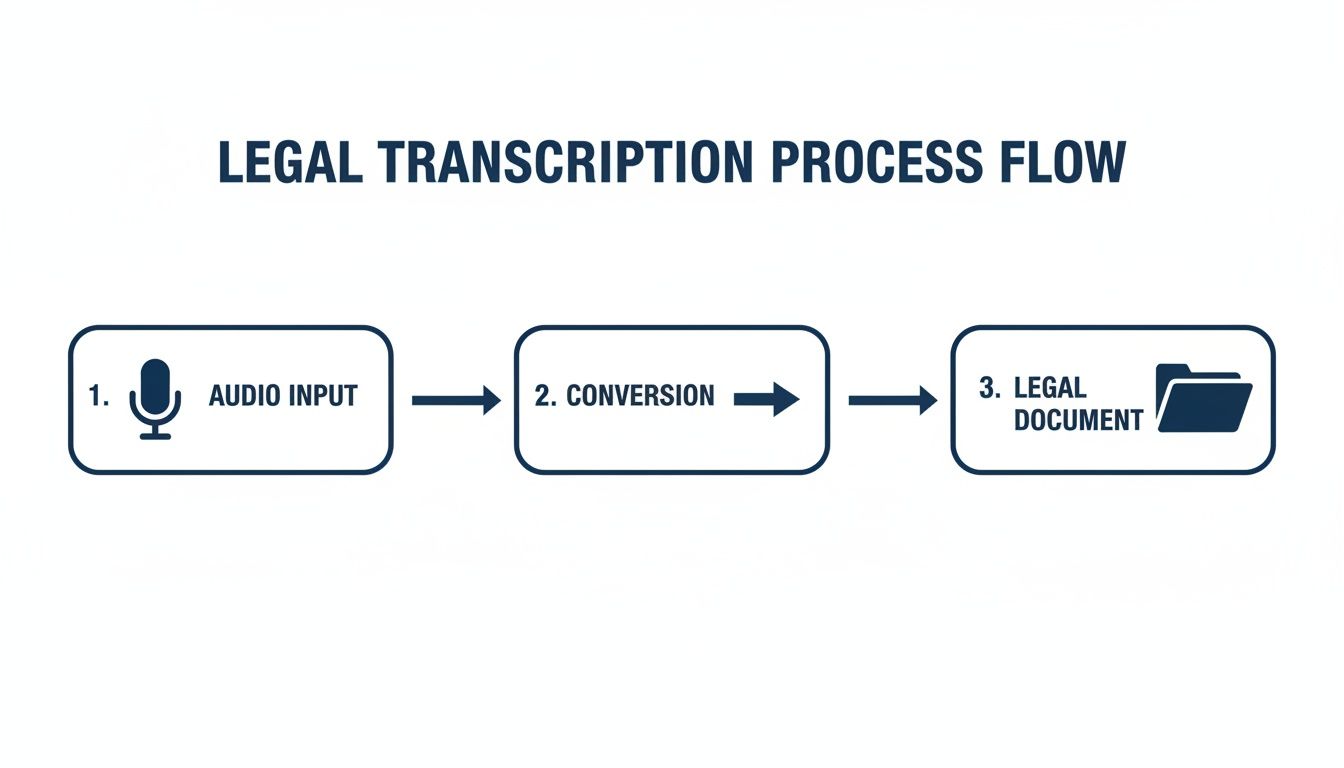
This visual really nails that critical handoff from recording to conversion, which is the engine driving the whole process.
The Human Touch of Quality Assurance
Here’s a critical point: a raw draft is never the finished product in a professional legal context. What comes next is what makes a transcript trustworthy and ready for court.
- Editing and Proofreading: A second pair of expert eyes—often a senior transcriptionist or legal professional—compares the draft line-by-line against the original audio. They hunt down typos, fix any misheard words, and ensure the punctuation is perfect. This is also when the document is formatted correctly and every speaker is properly identified.
- Quality Assurance (QA) Review: A final, rigorous QA check is performed to make sure every last detail is spot-on. This means triple-checking the spelling of names, places, and specific legal terminology. The benchmark here is an accuracy rate of 99% or higher, which is the absolute minimum standard for legal work.
- Secure Delivery and Integration: The finished transcript, often certified, is then sent back to the law firm through a secure, encrypted channel. Many modern services now plug directly into case management software, dropping the final document right into your firm’s existing workflow.
This multi-layered review process is what separates a generic text file from a certified legal transcript. It’s a system of checks and balances that ensures the final document can stand up in court as an official record.
4. Choosing Between Human and AI Transcription

When it comes to getting audio and video transcribed, law firms today have a serious choice to make: stick with the tried-and-true expertise of human transcriptionists or embrace the raw speed of artificial intelligence.
Each option brings something different to the table. The key isn't about finding a single "best" solution, but about understanding which tool is right for the job in front of you. After all, transcribing a quick internal memo is a world away from preparing a transcript for a federal court filing.
The Case for Human Expertise
For anything that requires absolute precision, human transcriptionists are still the undisputed champions. Their real value lies in the one thing algorithms can't yet replicate: genuine understanding. They hear the nuance, catch the context, and decode the complexities of human conversation.
This is where a human expert really shines:
- Deciphering Accents and Dialects: A skilled professional can navigate thick accents, regional slang, and fast-paced speech without missing a beat.
- Untangling Cross-Talk: They can meticulously separate overlapping speakers in a heated deposition or contentious hearing, correctly attributing every single word.
- Grasping Legal Jargon: Humans don't just hear legal terms; they understand their meaning and context, ensuring every "voir dire" or "res ipsa loquitur" is captured perfectly.
When a transcript could be entered as evidence or filed with the court, the 99%+ accuracy that a human professional provides is absolutely essential. There's simply no room for error.
The Power of AI-Driven Speed
On the other side of the coin, you have AI. What it lacks in nuance, it more than makes up for in speed and cost-effectiveness. When you need to churn through hours of audio quickly, AI is a game-changer.
AI is perfect for turning around first drafts of lengthy recordings, transcribing internal attorney dictations, or getting a searchable text version of a client interview. For firms exploring this route, understanding the differences between leading models, as detailed in comparisons like Claude vs ChatGPT, can help in selecting the right technology.
The Hybrid Model: Getting the Best of Both Worlds
Here’s the thing: the smartest firms aren't framing this as a strict "either/or" dilemma. Instead, they're blending the two into a powerful hybrid workflow.
This approach uses technology for the heavy lifting and human skill for the critical finishing touches. It’s a simple, yet incredibly effective, one-two punch.
- AI Kicks It Off: The AI platform runs an initial pass on the audio, converting it into a rough draft in just minutes.
- A Human Expert Steps In: A professional legal transcriptionist then takes that draft and meticulously reviews it. They fix the AI’s mistakes, correct speaker labels, format the document, and ensure every detail is perfect.
- The Result is a Certified Transcript: You end up with a court-ready, highly accurate document delivered faster and more affordably than with a purely manual process.
This combined strategy gives you the best of both worlds—the efficiency of AI and the bulletproof accuracy of human oversight. Many of the best AI transcription software platforms are now built to support this exact kind of collaborative workflow.
To really see how these options stack up, let's break them down side-by-side.
Human vs AI Transcription: A Feature Comparison
The table below provides a clear, at-a-glance comparison of what you can expect from each transcription method, helping you align the right service with your specific legal needs.
| Feature | Human Transcription | AI Transcription | Hybrid Model |
|---|---|---|---|
| Accuracy Rate | 99%+ with professional certification | 85%-98% depending on audio quality and model | 99%+ with human certification |
| Turnaround Time | 24-72 hours on average | Minutes to a few hours | 4-24 hours, faster than human-only |
| Cost | Highest per-minute rate | Lowest per-minute rate or subscription | Mid-range, more affordable than human-only |
| Handling Poor Audio | Excellent; can decipher background noise and low-quality recordings | Poor to fair; accuracy drops significantly with any audio issues | Good; AI provides a baseline, human corrects the difficult parts |
| Contextual Nuance | Excellent; understands sarcasm, legal terminology, and intent | Poor; cannot interpret non-literal speech or complex jargon | Excellent; human reviewer ensures all context is captured correctly |
| Speaker Identification | Highly accurate, can identify speakers even with similar voices | Fair to good, but often struggles with multiple speakers or cross-talk | Excellent; human reviewer corrects any AI errors in attribution |
| Security & Confidentiality | High, governed by strict NDAs and professional standards | Varies; requires review of provider’s security protocols (e.g., GDPR, HIPAA) | High; combines secure platform technology with human confidentiality agreements |
Ultimately, the choice comes down to your priorities for a given task. For a quick internal review, AI is a fantastic tool. But for anything that carries legal weight, the assurance of a human-reviewed, certified transcript is the only way to go. The hybrid model offers that assurance without the high cost and long wait times of traditional methods.
Meeting Critical Security and Compliance Standards
In the legal field, confidentiality is everything. It’s not just a professional courtesy; it’s a core ethical and legal mandate. This simple fact elevates security to the single most important factor when you're choosing any service that touches client data, and that goes double for legal transcription.
A data breach isn't just an IT headache. It can spiral into malpractice claims, bar sanctions, and a reputational nosedive that a firm might never recover from. That's why scrutinizing a potential transcription partner’s security setup isn’t just ticking a box—it’s a fundamental act of risk management.
Think about it: every file, from a raw deposition audio to the finished transcript, is a package of privileged information. It has to be shielded from prying eyes at every single step, which demands a robust, layered security strategy covering data both in transit and at rest.
Non-Negotiable Security Protocols
When you're vetting a transcription service, some security features are simply table stakes. They're the absolute minimum you should expect from anyone entrusted with your firm's sensitive information.
- End-to-End Encryption: This is your baseline. It means your files are scrambled and unreadable the second they leave your system (data in transit) and remain that way while stored on the provider's servers (data at rest).
- Secure Data Hosting: You have a right to know where your data is physically stored. Top-tier providers use data centers in jurisdictions with ironclad privacy laws, like Switzerland or countries within the EU, to meet strict global standards.
- Robust Access Controls: Not everyone in the chain needs access to everything. A solid system uses role-based permissions to ensure only specifically authorized individuals can view, handle, or download sensitive files.
Getting these details right is crucial. For a more comprehensive look, our complete law firm data security guide provides a much deeper dive into protecting client information across your entire practice.
A verifiable chain of custody is also vital. This is essentially a chronological log that tracks who handled the audio and transcript, and when. It’s a critical piece of the puzzle for preserving the integrity of any document that could become evidence.
Adhering to Legal and Regulatory Frameworks
Beyond the technical security measures, your transcription provider has to prove they understand and follow key regulations. Legal work constantly brushes up against personal, financial, and medical information, and each category comes with its own rulebook.
For instance, if you’re working on a case with clients in Europe, your partner absolutely must be GDPR-compliant. If the case involves patient information in the United States, HIPAA compliance is a must. Given how complex these rules can be, it's wise to look for solutions that help manage this. For a closer look at how technology can simplify this process, you might find A Guide to Compliance Automation Software helpful.
Ultimately, picking a provider who is fluent in these legal frameworks is a powerful way to shield your clients—and your firm—from serious legal and financial risk.
How Transcription Boosts Your Firm’s Efficiency
Good legal transcription isn't just about turning audio into text—it’s a powerful productivity engine that can fundamentally change the way your firm operates. It takes passive audio recordings and transforms them into active, searchable data that your entire team can use to build stronger cases, and do it faster.
Think about it. A paralegal could instantly pinpoint a key admission from a ten-hour deposition without having to scrub through the audio file manually. Or imagine an attorney finishing a client call and, within minutes, having a searchable transcript automatically dropped into the case file. This is how modern transcription stops being a reactive service and becomes a proactive tool for winning.
This shift is why we're seeing such a huge investment in the legal sector. The U.S. legal transcription market is expected to grow from USD 652.76 million in 2025 to USD 1,272.39 million by 2035. That’s not just a statistic; it’s a clear signal that firms see accurate transcription as essential for managing complex information and staying compliant.
Turning Spoken Words into Actionable Assets
When you build transcription directly into your workflow, the efficiency gains are immediate. Creating a written record moves from a time-consuming bottleneck to a catalyst for progress, making crucial information accessible to everyone in your firm.
Here are just a few practical ways it makes a difference:
- Accelerated Deposition Review: Instead of re-watching hours of video, your team can quickly search transcripts for keywords, identify critical testimony, and collaborate on the analysis.
- Faster Motion and Brief Drafting: Attorneys can copy and paste exact quotes from testimony directly into legal documents. This guarantees accuracy and cuts down drafting time dramatically.
- Improved Team Collaboration: Having a central, searchable record means everyone—from senior partners to junior associates—is on the same page, which eliminates confusion and wasted effort.
For a deeper dive into the available options, you might find our guide on choosing the right legal transcription services helpful for your firm's specific needs.
By making every spoken word searchable and citable, transcription turns conversations into a strategic advantage. It empowers your team to find the facts they need, precisely when they need them, helping to build a more agile and responsive legal practice.
Streamlining Your Firm’s Daily Operations
The benefits go far beyond major case milestones. Transcription also sharpens the daily tasks that eat up so much valuable time. Dictated notes, client intake calls, and internal strategy meetings can all be converted into organized, useful text.
This helps build a comprehensive and easily navigable case file. New team members can get up to speed much faster by reviewing key conversations, and information is never lost if someone is out of the office. Ultimately, this operational smoothness frees up your legal professionals to focus less on administrative chores and more on high-value legal work.
Picking the Right Legal Transcription Partner
Choosing who handles your firm's transcription isn't just an administrative task—it's a critical decision that directly affects case strategy, operational efficiency, and client confidentiality. With a flood of options out there, it’s easy to get overwhelmed. The key is to cut through the noise and evaluate potential partners against the rigorous standards of legal work.
A methodical approach is your best friend here. It helps you find a service that doesn't just produce accurate text but actually fits into how your practice operates.
Look at the Core Metrics First: Accuracy and Speed
Before you even think about price, you need to know if a service can deliver on the two fundamentals: accuracy and speed. In the legal world, there's no room for error. A single misplaced word can twist the meaning of testimony, so a 99% accuracy rate isn't just a goal; it's the absolute minimum standard.
Ask for their service level agreements (SLAs). Do they explicitly guarantee that 99% figure? More importantly, what's their process if a transcript falls short?
Turnaround time is the other side of that coin. Your deadlines are often non-negotiable. Can a provider consistently deliver on time, even when you have an urgent request that needs to be done in a few hours? Be clear about your needs—whether it's standard 24-hour delivery or rush jobs—and make sure they can genuinely handle the pressure.
Vetting a transcription service is a lot like hiring an expert witness. You need unshakable confidence in their credentials, their process, and their ability to perform under pressure. Their final product has to be beyond reproach.
Dig Into Pricing and Security Protocols
Once you've confirmed a provider can meet your performance standards, it's time to talk money and security. Pricing models are all over the map, from simple per-minute rates to subscriptions. Figure out your firm's average monthly transcription volume to see which model actually saves you money in the long run. A word of caution: be skeptical of rock-bottom prices. They often come at the cost of quality or, even worse, security.
And on that note, security is an area where you simply cannot compromise. Your provider must offer end-to-end encryption and comply with standards like GDPR or HIPAA if they apply to your cases. Ask them tough questions:
- What are your data storage policies?
- Who has access to our files?
- Are your transcriptionists bound by strict confidentiality agreements?
- Have they received specific training on handling sensitive legal documents?
To see how these critical features come together in practice, take a look at our detailed breakdown of leading legal transcription software.
Common Questions About Legal Transcription
Even with a solid grasp of what legal transcription involves, a few practical questions almost always pop up when firms start looking at their options. Let's tackle some of the most common ones head-on.
What Accuracy Level Is Actually Required for Legal Work?
For any official legal document that could end up in court—like deposition transcripts or official records—the gold standard is 99% accuracy or higher. This isn't just a nice-to-have; it's an absolute necessity.
Think about it: a single misplaced "not" or a misheard name can completely change the context of a testimony or contract. While AI is getting impressively close, that final 1% is where mistakes live. That's why this benchmark is still most reliably met by certified human transcriptionists or by hybrid AI services that include a final, meticulous human review.
Can We Really Trust AI with Confidential Client Data?
You can, but only if you choose a provider built specifically for the legal field. A generic, consumer-grade AI tool is not the place for sensitive client information.
A secure, legal-specific platform will offer end-to-end encryption and store your data in compliant, secure data centers (for example, servers located within the EU or Switzerland to meet GDPR standards).
A word of caution: Always, always vet a provider’s security credentials and data handling policies before uploading a single file. Never assume a tool is secure just because it's popular.
What’s the Difference Between a Transcriptionist and a Court Reporter?
This is a classic point of confusion, but the distinction is actually quite simple and comes down to timing.
- A court reporter (often called a stenographer) is on-site, capturing the spoken word in real-time as it happens during a live proceeding. They use a specialized stenotype machine to create the official record on the spot and are often certified officers of the court.
- A legal transcriptionist comes in after the fact. They work from an audio or video recording of an event—like a deposition, client interview, or dictated notes—to produce a verbatim written transcript.
In a nutshell, court reporters are live, while transcriptionists work from recordings. Both are crucial for creating an accurate legal record, they just operate at different points in the process.
Ready to transform your firm's productivity with a secure, AI-powered workspace designed for legal professionals? Whisperit unifies dictation, drafting, and collaboration, allowing your team to move from spoken word to finalized document faster than ever. Explore how our Swiss/EU hosting and GDPR-aligned controls can bring a calmer, more efficient workflow to your practice. Learn more at whisperit.ai.